
The bird dog exercise is a bodyweight core movement performed on your hands and knees, where you extend one arm and the opposite leg simultaneously while keeping your spine perfectly still. It trains your body to resist rotation and extension under load, which is exactly what your spine needs during everyday movements like walking, lifting, and bending.
Spine biomechanics researcher Dr. Stuart McGill at the University of Waterloo identified the bird dog as one of his “Big Three” exercises for spinal health. His research, published across multiple peer-reviewed journals, showed it activates the deep stabilizers of the spine without placing excessive compressive load on the lumbar discs.
This guide covers everything from the exact muscles the bird dog targets to how long you should hold each rep, how to program it into your week, and which variations work best for beginners, seniors, and people dealing with back pain. You will also find a direct comparison with the dead bug exercise and a clear breakdown of when to skip the bird dog entirely.
What Is a Bird Dog Exercise?
The bird dog (technically called the quadruped opposite arm and leg extension) is a core stabilization exercise performed from a hands-and-knees position. You extend your right arm forward and your left leg backward, hold briefly, return to start, and repeat on the other side.
Unlike a crunch or sit-up, the bird dog does not flex or extend your spine. Instead, it challenges your trunk to stay completely rigid while your limbs move. This trains anti-rotation and anti-extension stability, two patterns that directly transfer to real-world activities.
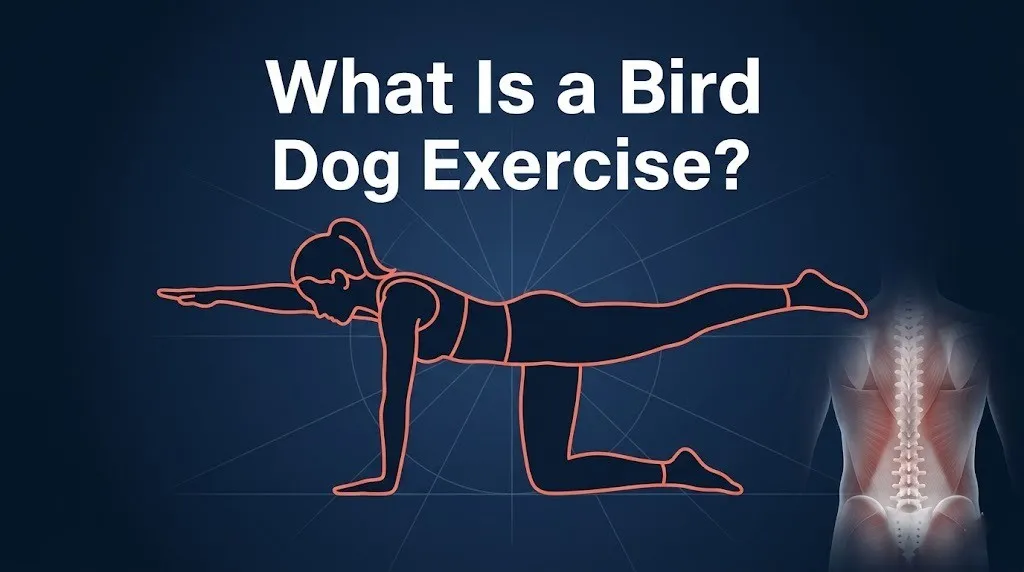
Physical therapists, personal trainers, and spine researchers all recommend the bird dog because it builds strength in the muscles surrounding the spine without putting the spine itself through repeated bending. That makes it one of the safest core exercises available for almost any fitness level.
Key Fact:
- Dr. Stuart McGill classified the bird dog as one of his “Big Three” spine stabilization exercises, alongside the curl-up and the side plank.
- The “Big Three” are designed to build endurance in the core musculature while minimizing spinal load.
- This classification has been widely adopted by physical therapists and strength coaches globally.
Bird Dog Exercise Muscles Worked
The bird dog activates both deep spinal stabilizers and larger superficial muscles across the back, glutes, and core. It is a full-trunk exercise, not just a “back exercise.”
Primary muscles targeted:
| Muscle | Role During Bird Dog |
|---|---|
| Erector spinae | Resists spinal flexion, maintains neutral spine |
| Multifidus | Stabilizes individual vertebral segments |
| Transverse abdominis | Creates intra-abdominal pressure, braces the core |
| Rectus abdominis | Prevents excessive lumbar extension |
| Gluteus maximus | Extends the hip to lift the rear leg |
Secondary muscles engaged:
- Posterior deltoid and upper back muscles stabilize and extend the reaching arm
- Hamstrings assist hip extension on the working leg
- Gluteus medius prevents the pelvis from dropping to one side
- Scapular stabilizers (lower trapezius, serratus anterior) keep the shoulder blade anchored
A study published in the Journal of Strength and Conditioning Research confirmed that the bird dog produces high activation in the multifidus and erector spinae while keeping lumbar compressive forces relatively low. This combination is rare among core exercises.
Bird Dog Exercise Benefits
The bird dog exercise builds spinal endurance, improves balance, and teaches your body to coordinate upper and lower limb movement without compensating through the lower back.
Here are the documented benefits:
- Spinal stability without spinal load. Unlike heavy deadlifts or squats, the bird dog strengthens the muscles around your spine without compressing the discs.
- Improved balance and coordination. Lifting opposite limbs forces your body to manage shifting weight, which trains proprioception.
- Better posture. Strengthening the erector spinae and deep stabilizers helps counteract the forward slouch from prolonged sitting.
- Transferable core strength. Anti-rotation and anti-extension stability carry over to walking, running, lifting groceries, and playing sports.
- Low injury risk. The bodyweight-only nature and slow tempo make it accessible for nearly all populations.
Research from the American Council on Exercise (ACE) ranks the bird dog among the most effective exercises for activating the deep core musculature without requiring equipment. ACE also notes that it is suitable for both rehab settings and athletic performance programs.
Quick Tip:
- Pair the bird dog with planks and side planks for a complete core stability routine.
- Performing it as a warm-up before heavy lifting can “wake up” the stabilizers and reduce injury risk.
- Even athletes who squat and deadlift heavy loads benefit from regular bird dog training.
Key Takeaway: The bird dog is a low-risk, high-reward exercise that strengthens the deep stabilizers of your spine, and spine researcher Stuart McGill considers it one of the three most important exercises for back health.
How to Do the Bird Dog Exercise
The bird dog is performed from a hands-and-knees (quadruped) position with a slow, controlled tempo. Rushing through this exercise defeats its purpose entirely.
To perform the bird dog correctly:
- Kneel on a mat with your hands directly beneath your shoulders and your knees directly beneath your hips. Your spine should be in a neutral position: slight natural curve in the lower back, no sagging or rounding.
- Brace your core by gently tightening your abdominal muscles as if someone were about to tap your stomach. Do not suck your belly in; just create mild tension.
- Simultaneously extend your right arm straight forward (thumb pointing toward the ceiling) and your left leg straight backward (toes pointing toward the floor behind you).
- Hold this position for 5 to 10 seconds while breathing normally. Your hips should not rotate. Your lower back should not arch.
- Return your arm and leg to the starting position slowly. Do not drop them.
- Repeat on the opposite side: left arm forward, right leg backward.
- Alternate sides for the prescribed number of repetitions.
The entire movement should feel like you are trying to make yourself as long as possible from fingertips to toes, while keeping your trunk perfectly still. Imagine balancing a glass of water on your lower back throughout.
Beginner modification: If extending both limbs at once feels unstable, start by lifting only the arm. Once that feels controlled, practice lifting only the leg. Progress to opposite arm and leg when you can keep your hips level during single-limb lifts.
Bird Dog Exercise Form Cues
Proper bird dog form requires you to maintain a rigid, neutral spine while your limbs move slowly and deliberately. Most errors come from moving too fast or overextending.
The best form cues to remember:
- “Long spine.” Think of reaching your head away from your tailbone. This cue prevents both rounding and arching.
- “Thumb to ceiling.” Point your thumb upward on the reaching arm. This externally rotates the shoulder and engages the upper back correctly.
- “Push the wall away.” On the extending leg, imagine pushing your heel into a wall behind you. This activates the glute more effectively than just lifting the leg.
- “Breathe behind the belt.” Breathe into your lower ribs and sides, not into your chest. This keeps your core braced without holding your breath.
- “Quiet hips.” Your pelvis should not shift, drop, or rotate. If someone placed their hands on your hip bones, those bones should stay perfectly level.
| Form Element | Correct | Incorrect |
|---|---|---|
| Spine position | Neutral, slight natural curve | Arched or rounded |
| Hip alignment | Level, no rotation | Dropping or twisting |
| Arm height | Parallel to the floor | Reaching above head level |
| Leg height | Parallel to the floor | Kicking up above hip level |
| Head position | In line with spine | Craning up or tucking chin |
| Breathing | Continuous, into lower ribs | Holding breath |
Quick Tip:
- Practice next to a mirror placed to your side. You will immediately see if your back is arching or your hips are shifting.
- Place a foam roller or light dowel along your spine (touching your head, upper back, and sacrum). If it falls off during the movement, your alignment needs work.
Bird Dog Exercise Common Mistakes
The most common bird dog mistake is lifting the arm and leg too high, which forces the lower back into excessive extension and defeats the purpose of the exercise.
Here are the errors trainers see most often:
- Hyperextending the lower back. Lifiting the leg too high causes the lumbar spine to arch. Your leg should only rise to hip height, creating a straight line from heel to head.
- Rotating the hips. When the leg lifts, the opposite hip often drops. This rotation means the core is not stabilizing effectively. Reduce range of motion until you can keep hips level.
- Rushing the tempo. Speed removes the stabilization challenge. Slow, controlled reps with a distinct hold at the top are where the real benefit lives.
- Holding the breath. Breath-holding increases intra-abdominal pressure excessively. Breathe continuously through each rep.
- Looking up. Craning the neck upward compresses the cervical spine. Keep your gaze on the floor about a foot in front of your hands.
- Collapsing the supporting shoulder. The hand on the ground should actively push the floor away. A sagging shoulder puts unnecessary stress on the rotator cuff.
According to the National Academy of Sports Medicine (NASM), compensatory movement patterns during the bird dog often reveal underlying core weakness or hip mobility restrictions. If you consistently cannot maintain a neutral spine, regressing to a single-limb version is the right call, not a failure.
Key Takeaway: The bird dog looks simple, but most people perform it too fast and with too much range of motion. Slow down, lower your limb height, and keep your hips perfectly still for maximum benefit.
How Long to Hold the Bird Dog Exercise
You should hold the bird dog exercise for 5 to 10 seconds per repetition. This duration is based directly on Dr. Stuart McGill’s research on spinal stabilization endurance.
McGill’s studies at the University of Waterloo found that short-duration isometric holds, repeated for multiple repetitions, build better muscular endurance in the spinal stabilizers than long holds. His reasoning is straightforward: holding a position for 30 to 60 seconds causes the stabilizer muscles to fatigue and form to break down, which can actually increase spinal stress rather than reduce it.
| Hold Duration | Recommended For | Source |
|---|---|---|
| 5 seconds | Beginners, rehab patients, seniors | McGill spine stability protocols |
| 8 to 10 seconds | Intermediate trainees, general fitness | McGill Big Three recommendations |
| 10+ seconds | Advanced trainees with excellent form | Only if form remains perfect |
| 30+ seconds | Not recommended | Increases fatigue-related compensation |
The pattern McGill recommends is a descending pyramid. Start with a set of 6 reps (holding each for 8 to 10 seconds), then do a set of 4 reps, then a set of 2 reps. This structure ensures the highest quality reps happen when the muscles are freshest.
Modification note: If you find your hips starting to rotate or your back arching before the hold time is up, shorten the hold. A 3-second hold with perfect form beats a 10-second hold with a sagging spine every time.
This is one of the most overlooked details in bird dog programming. Longer is not better. Controlled and repeatable is better.
Bird Dog Exercise Sets and Reps
A solid starting point for bird dog sets and reps is 3 sets of 6 to 10 repetitions per side, with each rep held for 5 to 10 seconds. Adjust based on your fitness level and training goal.
| Fitness Level | Sets | Reps Per Side | Hold Time | Rest Between Sets |
|---|---|---|---|---|
| Beginner | 2 to 3 | 5 to 6 | 5 seconds | 30 to 45 seconds |
| Intermediate | 3 | 8 to 10 | 8 to 10 seconds | 30 seconds |
| Advanced | 3 to 4 | 8 to 10 | 10 seconds | 20 to 30 seconds |
| Rehab/McGill Protocol | 3 (descending) | 6, 4, 2 | 8 to 10 seconds | 20 to 30 seconds |
For general fitness, performing the bird dog 2 to 3 times per week is sufficient. It works well as part of a warm-up before strength training, as a standalone core circuit paired with planks and dead bugs, or as a cooldown exercise on lower body training days.
The ACSM recommends that core stability exercises be included at least 2 days per week for general health. The bird dog fits this guideline perfectly because it does not create enough fatigue to require extended recovery between sessions.
Quick Tip:
- Count each side separately. Six reps per side means twelve total movements.
- If using the bird dog as a warm-up, 2 sets of 5 per side with 5-second holds is enough.
- For back pain management, follow the McGill descending pyramid: 6 reps, then 4, then 2.
Bird Dog Exercise for Core Stability
The bird dog is one of the most effective exercises for core stability because it trains the trunk to resist movement rather than create it. This anti-movement pattern is how your core actually functions during most real-world tasks.
When you carry groceries, walk on uneven ground, or pick up a child, your core’s job is to prevent your spine from collapsing, twisting, or overextending. The bird dog trains exactly this function. Your arms and legs move. Your trunk stays perfectly rigid.
Research published in the Journal of Orthopaedic and Sports Physical Therapy has demonstrated that exercises requiring the core to resist rotation (anti-rotation exercises) produce higher activation in the deep stabilizer muscles, particularly the multifidus and transverse abdominis, compared to traditional flexion-based exercises like crunches.
The bird dog specifically challenges two stability patterns at once:
- Anti-extension: Your core resists the tendency for your lower back to arch as the leg extends behind you.
- Anti-rotation: Your core resists the tendency for your pelvis and torso to rotate as opposite limbs move.
This dual challenge is why the bird dog shows up in both physical therapy clinics and professional athletic training facilities. It is equally useful for a 70-year-old recovering from a back injury and a 25-year-old preparing for competitive sports.
Key Fact:
- The bird dog activates the multifidus at levels comparable to exercises performed with much heavier external loads, according to EMG studies published in spine biomechanics research.
Key Takeaway: Hold the bird dog for 5 to 10 seconds per rep, not 30 or 60 seconds, and use a descending pyramid set structure (6, 4, 2 reps) for the best spinal endurance results based on McGill’s research.
Bird Dog Exercise for Lower Back Pain
The bird dog exercise is one of the most commonly prescribed movements for people with lower back pain because it strengthens the spinal stabilizers without flexing, extending, or rotating the spine under load.
Dr. Stuart McGill’s clinical protocols for patients with low back pain center heavily on the bird dog. His research demonstrated that many people with chronic back pain have reduced endurance in their spinal stabilizers, particularly the multifidus and erector spinae. The bird dog rebuilds this endurance without exposing the spine to the repeated flexion cycles that aggravate disc injuries.
The key for back pain sufferers is to perform the exercise with strict adherence to neutral spine mechanics. Any arching, sagging, or rotation during the movement can increase discomfort rather than reduce it.
Guidelines for bird dog with lower back pain:
- Start with single-limb lifts only (arm or leg, not both) until you can maintain perfect spinal alignment.
- Hold for 5 seconds per rep. Build up to 8 to 10 seconds over several weeks.
- Perform on a padded surface. Hard floors can create knee discomfort that causes you to shift your weight unevenly.
- Stop immediately if you experience sharp, shooting, or radiating pain. Dull muscular fatigue in the back is normal; nerve-type pain is not.
If you have been diagnosed with a herniated disc, spinal stenosis, or spondylolisthesis, the bird dog may still be appropriate, but the specific variation and range of motion should be guided by your treating physical therapist or orthopedic specialist. These conditions respond differently to extension-based positions, and individual assessment matters.
Bird Dog Exercise Variations
Once you can perform 10 controlled reps per side with an 8-to-10-second hold and perfect form, adding bird dog variations keeps the exercise challenging and prevents your stabilizers from adapting to the same stimulus.
| Variation | Difficulty | What Changes |
|---|---|---|
| Single-limb bird dog | Easiest | Lift only arm or only leg |
| Standard bird dog | Beginner to Intermediate | Opposite arm and leg, 5 to 10 sec hold |
| Bird dog with elbow-to-knee crunch | Intermediate | Bring elbow and knee together under your torso between reps |
| Bird dog with resistance band | Intermediate to Advanced | Loop a band around foot and opposite hand for added resistance |
| Bird dog from plank position | Advanced | Perform from a push-up position instead of hands-and-knees |
| Bird dog on a stability ball | Advanced | Drape torso over a stability ball; greatly increases instability |
| Weighted bird dog | Advanced | Hold a light dumbbell in the reaching hand or add an ankle weight |
The bird dog with elbow-to-knee crunch adds a dynamic spinal flexion component between the isometric holds. This is appropriate for people without back pain who want to add movement variety. It is not recommended for anyone currently managing a disc injury.
The plank-position bird dog (sometimes called a “bird dog row” without the row) dramatically increases the anti-extension demand on the core. Your body must stabilize from a much less supported position. Only attempt this if you can hold a standard plank for at least 45 seconds with solid form.
Modification for limited mobility: If wrist discomfort prevents you from bearing weight on your hands, perform the bird dog from your forearms instead. Place your elbows directly beneath your shoulders and execute the same movement pattern.
Bird Dog Exercise for Beginners
If you are new to the bird dog exercise, the single most important thing is to master spinal alignment before adding any limb movement at all.
Beginner bird dog progression:
- Quadruped hold. Simply hold the hands-and-knees position with a neutral spine for 15 to 20 seconds. Focus on breathing and core bracing. Repeat 3 times.
- Single-arm lift. From the quadruped position, extend one arm forward while keeping everything else still. Hold 5 seconds. Alternate arms for 5 reps per side.
- Single-leg lift. Extend one leg backward while keeping hips level. Hold 5 seconds. Alternate legs for 5 reps per side.
- Opposite arm and leg (standard bird dog). Combine the two movements. Hold 5 seconds. Start with 5 reps per side.
This progression typically takes 1 to 3 weeks depending on your starting fitness level. There is no rush. Moving to the full version before you can keep your hips level during single-limb lifts will only reinforce bad movement patterns.
Common beginner concerns:
- “My knees hurt on the floor.” Use a folded towel or thick yoga mat beneath your knees.
- “I feel wobbly.” Widen your hand and knee placement slightly. A wider base of support increases stability.
- “I don’t feel anything working.” Slow down. Add a 2-second pause at the top. Focus on squeezing the glute of the extended leg and reaching as far forward as possible with the arm.
The American Council on Exercise (ACE) recommends the bird dog as one of the first core exercises beginners should learn because it teaches core bracing in a low-risk position. Unlike a plank, it does not require upper body strength to sustain the hold, making it accessible for people who lack push-up capacity.
Key Takeaway: Beginners should master single-limb lifts before progressing to the full bird dog, and widening the base of support is a simple fix for anyone who feels unstable.
Bird Dog vs Dead Bug Exercise
The bird dog and the dead bug are both anti-extension core exercises that train spinal stability without spinal movement, but they challenge the body from different positions and suit different needs.
| Feature | Bird Dog | Dead Bug |
|---|---|---|
| Starting position | Hands and knees (prone quadruped) | Lying on back (supine) |
| Gravity challenge | Resists extension from above | Resists extension from below |
| Primary stability demand | Anti-rotation + anti-extension | Anti-extension (primarily) |
| Better for people with | General back pain, weak glutes | Difficulty maintaining neutral spine, neck pain |
| Equipment needed | None (mat recommended) | None (mat recommended) |
| Difficulty for beginners | Moderate (balance component) | Slightly easier (back supported by floor) |
| Glute activation | Higher (leg extends against gravity) | Lower (leg lowers with gravity assist) |
The dead bug is often the better starting point for someone who cannot yet maintain a neutral spine during the bird dog. Lying on your back gives you tactile feedback: you can feel whether your lower back is pressing into or lifting off the floor. That feedback loop helps people learn core bracing faster.
However, the bird dog is the more functional choice for long-term training. Standing, walking, and lifting all happen in an upright or bent-over position, and the bird dog trains the core in a position closer to those real-world demands.
Practical recommendation: Use both. Start your core work with the dead bug to activate your deep stabilizers with floor feedback, then progress to the bird dog for a greater stability challenge. This pairing is a standard approach in many physical therapy and athletic training programs.
Bird Dog Exercise Progression
Progressing the bird dog exercise means increasing the stability demand, the time under tension, or the external load over time. Simply doing more reps of the standard version has diminishing returns after a few weeks.
Four-stage progression model:
- Stage 1 (Weeks 1 to 2): Single-limb bird dogs. Arm only, then leg only. 2 to 3 sets of 5 reps per side, 5-second holds.
- Stage 2 (Weeks 3 to 4): Standard bird dog with opposite arm and leg. 3 sets of 6 to 8 reps per side, 8-second holds.
- Stage 3 (Weeks 5 to 8): Add the elbow-to-knee crunch between holds, or loop a light resistance band around foot and hand. 3 sets of 8 to 10 reps per side, 10-second holds.
- Stage 4 (Weeks 9+): Plank-position bird dog, stability ball bird dog, or weighted bird dog with 2 to 5 lb dumbbell. 3 sets of 6 to 8 reps per side, 10-second holds.
Do not skip stages. Each one builds the neuromuscular control and endurance foundation for the next. Jumping to a plank-position bird dog without mastering the standard version is like running before you can walk steadily.
Signs you are ready to progress:
- You can complete all prescribed sets and reps with zero hip rotation.
- Your lower back does not arch at any point during the set.
- You do not feel challenged during the hold phase.
- Your breathing stays calm and controlled throughout.
A study published in Medicine and Science in Sports and Exercise found that progressive overload of stabilization exercises, including the bird dog, produced measurable improvements in trunk stiffness and endurance over 8-week training periods. The key variable was not just volume but progressive difficulty.
Bird Dog Exercise for Seniors
The bird dog exercise is one of the safest and most effective core exercises for seniors because it strengthens the muscles that prevent falls, support posture, and protect the spine, all without requiring heavy loads or high-impact movement.
Age-related loss of muscle mass (sarcopenia) affects the spinal stabilizers just as much as it affects the arms and legs. Weaker spinal stabilizers contribute to poor posture, increased fall risk, and chronic low back discomfort. The bird dog directly addresses all three.
Modifications for seniors:
| Modification | Purpose |
|---|---|
| Perform near a wall or sturdy chair for support | Provides something to grab if balance is lost |
| Use a thick mat or cushion under knees | Reduces joint discomfort |
| Lift only one limb at a time | Reduces balance demand |
| Shorten hold to 3 to 5 seconds | Prevents fatigue-related form breakdown |
| Perform from a standing position leaning on a counter | Eliminates the need to get on and off the floor |
The standing bird dog variation deserves special mention for seniors with difficulty getting down to the floor. Lean forward with hands on a kitchen counter, shift weight to one leg, and slowly extend the other leg behind you. This provides the same hip extension and core bracing pattern without the floor-to-standing transition.
The Centers for Disease Control and Prevention (CDC) recommends balance and muscle-strengthening activities at least 2 days per week for adults 65 and older. The bird dog satisfies both categories simultaneously.
Safety note for seniors: If you have osteoporosis, the hands-and-knees position is generally safe, but rapid transitions on and off the floor carry fall risk. Use a chair for support when lowering yourself to the mat and when standing back up.
Key Takeaway: Seniors benefit enormously from bird dogs, and a standing version using a kitchen counter provides the same core and hip benefits for those who cannot comfortably get on the floor.
Bird Dog Exercise Contraindications
The bird dog exercise is contraindicated in a small number of specific situations where the position or movement pattern could worsen an existing condition.
When to avoid or modify the bird dog:
- Acute spinal injury. If you have sustained a recent spinal fracture, disc herniation, or spinal cord injury, do not perform any exercises until your treating physician or surgeon has cleared you for movement.
- Recent spinal surgery. Post-operative restrictions vary by procedure. Lumbar fusion patients, for example, typically need 6 to 12 weeks before any quadruped exercises are introduced, and only under direct supervision of a physical therapist.
- Severe shoulder impingement or rotator cuff tear. The arm extension component places load through the shoulder joint. If reaching forward causes sharp shoulder pain, perform the leg-only version until the shoulder issue is resolved.
- Acute wrist injury or carpal tunnel syndrome (severe). Weight-bearing through the hands may be painful. Use forearms instead, or perform the standing counter-supported version.
- Late-stage pregnancy (third trimester, some individuals). The hands-and-knees position is generally well tolerated during pregnancy, but some individuals in the third trimester find it uncomfortable due to abdominal size or ligament laxity. A modified version with reduced range of motion or the standing variation may be more appropriate.
When the bird dog is fine but should be modified:
- Mild to moderate back pain: reduce range of motion and hold time.
- Knee discomfort: pad the knees heavily or switch to the standing version.
- Balance disorders: perform near a wall and lift only one limb at a time.
The bird dog is one of the most broadly accessible exercises in existence. True contraindications are rare. For the vast majority of people, including those with chronic back pain, the exercise is not only safe but actively recommended by spine specialists.
Frequently Asked Questions About the Bird Dog Exercise
How many bird dog reps should a beginner do?
Beginners should start with 5 to 6 reps per side for 2 to 3 sets, holding each rep for 5 seconds.
Once form is consistently solid, increase to 8 reps per side with an 8-second hold.
Master single-limb versions first if the full exercise feels unstable.
Is the bird dog exercise good for herniated discs?
The bird dog is often recommended for herniated discs because it strengthens spinal stabilizers without flexing or compressing the spine.
However, the specific variation and range of motion should be guided by a physical therapist who has assessed your individual condition.
Start with single-limb lifts and very short holds to test your tolerance before progressing.
Can you do bird dogs every day?
Yes, performing bird dogs daily is safe for most people because the exercise creates minimal muscular damage and joint stress.
Dr. Stuart McGill recommends daily practice of his Big Three exercises, including the bird dog, for people managing back pain.
For general fitness purposes, 3 to 5 sessions per week is plenty.
Why do I feel the bird dog exercise in my lower back?
Feeling your lower back muscles working during the bird dog is normal because the erector spinae is a primary stabilizer during this exercise.
However, sharp pain or discomfort concentrated in a single spot may indicate excessive lumbar extension.
Lower your leg height, shorten the hold, and focus on bracing your abdominals more firmly before each rep.
Should you hold the bird dog or do reps?
You should do both: perform individual repetitions with a 5-to-10-second hold at the top of each one.
This approach, based on McGill’s research, builds muscular endurance in the spinal stabilizers more effectively than either fast reps or long static holds.
The descending pyramid (6 reps, then 4, then 2) per set is the most evidence-backed format.
The bird dog earns its reputation as one of the best exercises for spinal health because it does what most “core” exercises fail to do: it trains the muscles your back actually needs, in the pattern your back actually uses, without beating your spine up in the process.
Start with the basics. Master a 5-second hold with level hips and a rigid trunk. Progress only when you own the current stage completely. Whether you are 25 or 75, rehabbing an injury or training for sport, this exercise belongs in your routine.