
Shin pain without exercise is more common than most people realize, and it almost always points to something specific happening in your body. Whether your shins ache while sitting, throb at night, or feel sore after a long day on your feet, there is usually a clear reason behind it.
The shin is one of the most structurally busy areas of the lower leg. It houses the tibia (the main weight-bearing bone), the anterior tibialis muscle, major blood vessels, and several nerve pathways. According to the Cleveland Clinic, non-traumatic leg pain accounts for a large portion of musculoskeletal complaints in adults, and many of those cases have nothing to do with athletic activity.
This article covers 14 specific, evidence-based causes of shin pain that have nothing to do with running or working out. You will learn how to identify which category fits your situation, what symptoms signal something more serious, and what steps you can take right now to find some relief.
Why Do My Shins Hurt Without Exercise?
Shins hurt without exercise because the tibia, surrounding muscles, blood vessels, and nerves in your lower leg are affected by far more than just physical training. Conditions ranging from poor circulation and nerve compression to nutritional deficiencies and medication side effects can all produce shin pain in people who are completely sedentary.
The tibia is the second-largest bone in the body. It bears roughly 85% of your body weight during standing and walking. That constant load, even without formal exercise, creates daily mechanical stress that can become painful when something else is off.
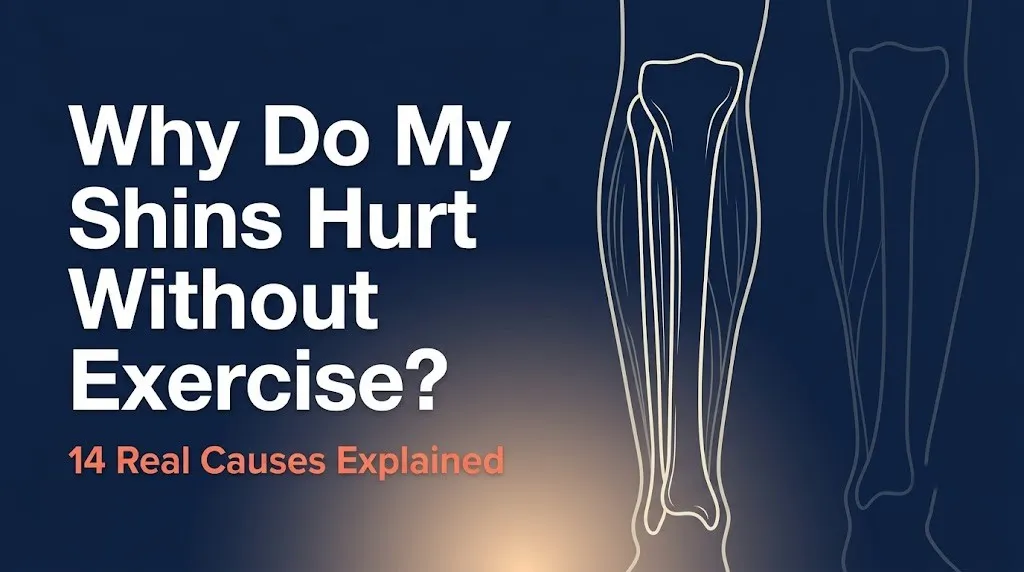
Think of the shin area as a crossroads. Blood vessels, nerves, muscle compartments, and bone all share a compact space in your lower leg. When any one of those systems is stressed, inflamed, or compressed, the pain registers in the same general area regardless of what caused it.
Understanding the cause matters more than treating the symptom. Applying ice to a shin that hurts from a circulation problem will not help the same way it helps a bruised shin. Knowing the origin changes the approach entirely.
Key causes at a glance:
| Category | Common Examples |
|---|---|
| Vascular | Peripheral artery disease, venous insufficiency |
| Neurological | Nerve compression, referred lumbar pain |
| Bone-related | Tibial stress reaction, tibial periostitis |
| Biomechanical | Flat feet, poor posture, worn footwear |
| Nutritional | Vitamin D deficiency, calcium imbalance |
| Medication-related | Statin myalgia, antibiotic-related tendon pain |
| Lifestyle | Prolonged standing, sedentary sitting patterns |
Non-Exercise Causes of Shin Pain
Non-exercise shin pain refers to discomfort in the lower leg that develops or persists without any athletic activity as a trigger. It is not a single condition; it is a symptom produced by one of several underlying causes.
Most people assume shin pain is always a sports injury. That assumption leads them to rest and wait, which only helps if the cause is overuse. For vascular, neurological, or nutritional causes, waiting without addressing the root issue rarely brings improvement.
The distinction between activity-related and non-activity-related shin pain matters clinically. Activity-related pain typically appears during or immediately after movement. Non-exercise shin pain tends to be present during rest, worsen at certain times of day, or be associated with other body-wide symptoms.
Common patterns that suggest a non-exercise cause:
- Pain present first thing in the morning before any walking
- Aching or throbbing that intensifies at night
- Pain in both shins simultaneously without any training load
- Shin discomfort accompanied by swelling, skin changes, or numbness
- Pain that does not respond to standard RICE (rest, ice, compression, elevation) protocol
The location of the pain also offers clues. Anterior shin pain (front of the leg) often points to bone, muscle, or nerve issues. Posterior shin pain (back of the lower leg) more frequently involves vascular or deep muscular causes.
Shin Pain at Rest: What Your Body Is Telling You
Shin pain that occurs specifically at rest is your body signaling that something systemic or structural is affecting the lower leg, not just a muscle responding to training stress. Rest pain is taken more seriously by clinicians because it rules out the most benign explanation.
When you stop moving, blood flow patterns change. Muscles relax. Gravity still acts on your venous system. For someone with a vascular condition, rest can actually worsen symptoms because the protective effect of muscle-pump contractions is gone. For someone with a nerve compression issue, certain resting positions may increase pressure on an irritated nerve root.
According to the Mayo Clinic, leg pain at rest that is accompanied by coolness, pallor, or numbness warrants prompt medical evaluation to rule out arterial insufficiency.
The pattern of rest pain is a meaningful diagnostic clue:
| Rest Pain Pattern | Possible Cause |
|---|---|
| Worse lying flat, better with legs elevated | Venous insufficiency |
| Worse with legs elevated, better hanging down | Peripheral artery disease |
| Worse in one specific position (e.g., lying on side) | Nerve root compression |
| Diffuse aching, both legs, no positional change | Vitamin/mineral deficiency |
| Sharp, localized, worse with any pressure | Bone-related pathology |
| Burning or tingling alongside aching | Neuropathic origin |
Tracking when and how your shin pain behaves at rest gives you and any clinician you see a much clearer starting point.
Key Takeaway: Shin pain without exercise is almost always traceable to a specific cause. The location, timing, and behavior of your pain at rest are your best clues for narrowing it down.
Vascular Causes of Shin Pain
Vascular conditions are among the most underrecognized causes of shin pain in people who do not exercise. Peripheral artery disease (PAD) and venous insufficiency are the two most common vascular sources.
Peripheral artery disease occurs when plaque narrows the arteries supplying blood to the legs. In its early stages, pain often appears during walking (a pattern called claudication). In more advanced stages, PAD produces pain at rest, particularly in the feet and lower legs, including the shin area.
Venous insufficiency is different. Here, the issue is not arterial supply but venous return. Valves in the leg veins weaken, allowing blood to pool in the lower leg. This produces a heavy, aching, or throbbing sensation, often in the shin and calf, that worsens after prolonged sitting or standing and tends to ease with leg elevation.
According to the National Institutes of Health (NIH), PAD affects approximately 8 to 12 million Americans, and a significant percentage remain undiagnosed because symptoms are dismissed as general leg fatigue or aging.
Deep vein thrombosis (DVT), while less common, can also cause shin or lower leg pain, often with swelling, warmth, and redness on one side. DVT requires immediate medical evaluation. If your shin pain is on one side only and accompanied by visible swelling, this is not something to manage at home.
Vascular shin pain red flags:
- Pain in one or both legs at rest, particularly at night
- Leg skin that appears shiny, pale, or discolored
- One leg noticeably cooler than the other
- Swelling in the lower leg with or without redness
Nerve Compression and Referred Shin Pain
Nerve compression is a frequently missed cause of shin pain in people who have not done anything athletic. The L4 nerve root, which exits the lumbar spine between the fourth and fifth lumbar vertebrae, has a distribution pattern that runs directly down the anterior shin.
When this nerve root is irritated by a herniated disc, bone spur, or spinal stenosis, the pain can present entirely in the shin area with no obvious back symptoms at all. Clinicians call this referred pain or radiculopathy. Many people with L4-L5 nerve root irritation report a dull, burning, or electric shin ache that appears to have no local cause.
The common peroneal nerve, which wraps around the fibular head just below the knee, is another structure that can become compressed. People who habitually cross their legs, kneel for long periods, or recently spent extended time with the leg in an awkward position may compress this nerve, producing tingling, numbness, and pain along the outer shin and top of the foot.
Chronic exertional compartment syndrome can also cause symptoms at rest in some individuals. The anterior compartment of the lower leg contains the tibialis anterior muscle and several nerves within a tight fascial enclosure. When this compartment remains elevated in pressure even at rest, the result is persistent shin aching and tightness.
Signs pointing to a nerve-related shin cause:
- Burning, tingling, or electric sensation rather than pure aching
- Numbness in the shin, foot, or toes alongside the pain
- Pain that changes with spinal position (bending forward or back)
- History of lower back problems, even mild
Shin Splints Without Running: Is It Possible?
Shin splints without running is entirely possible, and the condition is often misunderstood as being exclusively a runner’s problem. Medial tibial stress syndrome (MTSS), the technical name for shin splints, involves inflammation of the periosteum (the connective tissue surrounding the tibia) and the muscles attached to it.
The periosteum does not only get irritated by running. Prolonged walking on hard surfaces, sudden increases in daily step count, carrying heavy loads, or even prolonged standing can create the repetitive tibial stress that triggers periosteal inflammation.
Tibial periostitis, a related condition, involves more chronic inflammation of this same outer bone layer. It can develop gradually in people who stand on hard floors for work, walk on uneven surfaces regularly, or have underlying biomechanical issues like flat feet that place abnormal stress on the inner tibia.
A study published in Medicine and Science in Sports and Exercise found that MTSS is not exclusive to trained athletes. Occupational and lifestyle-related tibial stress can produce identical periosteal changes in non-exercising individuals.
Anterior tibialis stretch (also called the tibialis anterior stretch): This is the most commonly recommended self-care movement for reducing anterior shin tightness.
To perform a seated anterior tibialis stretch:
- Sit upright in a chair with both feet flat on the floor.
- Slide one foot back so the top of the toes rests lightly on the floor.
- Gently press the top of the foot downward, feeling a mild stretch along the front of the shin.
- Hold for 20 to 30 seconds. Breathe steadily throughout.
- Release and repeat 3 times per side.
Beginner modification: Perform lying down, pointing and flexing the foot gently without any floor pressure.
For limited mobility: A seated ankle alphabet exercise (drawing letters in the air with the toes) provides gentle tibialis movement without weight-bearing.
Skip this if: You have a confirmed stress fracture, active bone injury, or acute shin swelling with warmth.
Key Takeaway: Shin splints and tibial stress conditions are not exclusive to athletes. Prolonged standing, daily walking loads, and biomechanical issues can all inflame the periosteum of the tibia in people who never exercise.
Tibial Stress Reactions and Bone-Related Shin Pain
A tibial stress reaction is a pre-fracture bone response where the tibia is accumulating more damage from repetitive loading than it can repair in normal time. It sits on a continuum between healthy bone adaptation and a full stress fracture. Importantly, stress reactions can develop in people who walk a lot for work or daily life, not only in athletes.
The tibia is the most common site for stress fractures in the lower extremity. Bone responds to repetitive mechanical load by remodeling. When the load outpaces recovery, the bone develops micro-damage. In people with low bone density, nutritional deficiencies, or high daily step counts on hard surfaces, this can happen without any formal exercise at all.
According to a review in the Journal of Bone and Mineral Research, individuals with low vitamin D levels, low calcium intake, or osteopenia show a meaningfully higher rate of tibial stress injury across all activity levels, including sedentary and lightly active populations.
Signs that bone may be involved:
- Pinpoint tenderness on pressing directly on the shin bone
- Pain that is worse with brief weight-bearing and eases completely with full rest
- Gradual onset that has been worsening over weeks
- A history of osteoporosis, nutritional restriction, or prolonged corticosteroid use
Bone-related shin pain should not be self-managed for more than a few days without clinical assessment. An X-ray may miss early stress reactions; an MRI or bone scan is more sensitive for confirming bone stress injuries before fracture develops.
Who is at higher risk:
- Postmenopausal women with reduced bone density
- Anyone who takes corticosteroids long-term
- People with a history of eating disorders
- Adults with known vitamin D or calcium deficiency
Shin Pain From Flat Feet, Posture, and Footwear
Flat feet (technically called pes planus) alter the mechanical load distribution through the entire lower leg. When the medial arch collapses, the tibia rotates inward, placing excessive tensile stress on the muscles and periosteum along the inner shin.
This is one of the most common biomechanical causes of shin pain in people who never exercise. You do not need to run for flat feet to cause tibial stress. A full day of standing or walking in unsupportive footwear is enough to produce cumulative tibial loading that results in aching shin pain by evening.
Overpronation (excessive inward rolling of the foot during the gait cycle) is closely related to flat feet and produces a similar tibial stress pattern. Both conditions respond well to orthotic insoles that restore arch support and reduce tibial rotation.
Footwear matters as much as foot structure. Worn-out shoes, minimalist footwear on hard floors, or high heels that alter tibial alignment all change how load travels through the shin.
Postural factors add another layer. Prolonged standing with knees locked, hip misalignment, or habitual weight shifting to one side all change the mechanical environment of the tibia.
Quick Tip:
- Replace footwear every 400 to 500 miles of walking or every 6 to 12 months if worn daily.
- Try inserting over-the-counter arch support insoles before investing in custom orthotics.
- If pain is worse on one side, check if you habitually shift weight onto that leg while standing.
Beginner modification: Practice standing with feet hip-width apart and weight evenly distributed. Use a mirror or video to check whether your arches collapse during normal standing.
For limited mobility: Perform seated foot arch exercises (short-foot exercise, or “toe spreading”) to strengthen intrinsic foot muscles without weight-bearing load.
Skip biomechanical self-correction if: Pain is acute, swollen, or accompanied by significant tenderness on the bone itself.
Shin Pain From Standing All Day
Standing all day is one of the most common overlooked causes of shin pain in non-exercising adults. It is particularly prevalent in people who work retail, food service, healthcare, or manufacturing roles where they are on their feet for 6 to 10 hours daily.
The mechanism is straightforward. Sustained vertical loading compresses the tibia, fatigues the anterior tibialis and surrounding calf muscles, and reduces venous return in the lower leg. By the end of a long standing shift, the resulting combination of tibial stress, muscular fatigue, and venous pooling creates an aching, heavy shin pain that many people simply accept as normal.
It is not normal. It is a load management problem.
The American College of Sports Medicine (ACSM) notes that prolonged static standing creates cardiovascular and musculoskeletal demands comparable to low-intensity exercise, particularly for the postural muscles of the lower leg.
To reduce standing-related shin pain:
- Use anti-fatigue mats wherever you stand for extended periods.
- Shift weight between legs every 20 to 30 minutes.
- Elevate one foot on a low step or footrest periodically to change tibial loading.
- Take 5-minute seated breaks every 90 minutes when possible.
- Perform gentle calf raises (standing on both feet, rising onto toes and lowering slowly) during breaks to activate the muscle pump and improve venous return.
Beginner modification for calf raises: Perform seated calf raises (lifting heels from the floor while sitting) if standing calf raises are uncomfortable.
For those with knee or ankle conditions: Ankle circles while seated provide similar circulatory benefit without joint loading.
Skip calf raises if: You have an active Achilles tendon injury, calf muscle tear, or confirmed DVT.
Key Takeaway: Standing for work is a legitimate source of shin stress, and it deserves the same load management attention as athletic training. Small positional changes during the workday make a measurable difference.
Medication-Related Shin Pain
Medication-related shin and leg pain is one of the most missed causes in adults who cannot explain their discomfort. Several widely prescribed drug classes are known to produce myalgia (muscle pain), bone pain, or tendon irritation that can manifest in the shin area.
Statins (including atorvastatin and simvastatin), which are among the most commonly prescribed medications worldwide, cause muscle-related side effects in a documented subset of users. According to the NIH, statin-associated muscle symptoms (SAMS) affect between 5% and 29% of statin users in observational studies. The pain is typically described as aching, heaviness, or cramping in the large muscle groups of the legs, including the lower leg and shin area.
Fluoroquinolone antibiotics (such as ciprofloxacin and levofloxacin) have a well-documented association with tendon damage and musculoskeletal pain, including in the lower leg. The U.S. Food and Drug Administration has required black box warnings on these medications related to tendinopathy risk.
Bisphosphonates, used to treat osteoporosis, occasionally produce bone pain as a side effect. Atypical femoral fractures have been documented with long-term use, and some users report generalized leg bone aching.
Medications worth considering if your shin pain is unexplained:
| Drug Class | Common Examples | Reported Leg/Shin Effect |
|---|---|---|
| Statins | Atorvastatin, simvastatin | Muscle aching, heaviness |
| Fluoroquinolones | Ciprofloxacin, levofloxacin | Tendon pain, lower leg aching |
| Bisphosphonates | Alendronate, risedronate | Bone pain |
| Loop diuretics | Furosemide | Muscle cramps, electrolyte-related pain |
| Corticosteroids (long-term) | Prednisone | Bone density loss, muscle weakness |
If you recently started or changed a medication and noticed shin pain shortly after, review the medication’s known side effects and speak with the prescribing clinician about whether the timing suggests a connection. Do not stop any prescription medication without medical guidance.
Vitamin D Deficiency and Shin Bone Pain
Vitamin D deficiency is a direct and physiologically explainable cause of bone pain, and the shin is one of the most common locations where this pain is felt. The tibia is a large, superficial bone, and it is particularly susceptible to the aching that comes with inadequate vitamin D and calcium metabolism.
Vitamin D is required for calcium absorption in the gut. Without adequate vitamin D, the body cannot maintain proper bone mineralization. When bone is under-mineralized, the periosteum (the highly nerve-rich outer layer of bone) can become sensitized, producing a deep, diffuse aching that is often described as being “inside the bone.”
This condition, in its most severe form, is called osteomalacia (soft bones in adults). Milder vitamin D insufficiency can produce similar shin bone aching without the full clinical picture of osteomalacia.
According to a National Institutes of Health (NIH) analysis, approximately 35% of U.S. adults have some degree of vitamin D insufficiency, with higher rates in people who spend limited time outdoors, have darker skin tones, or follow restrictive diets.
Symptoms suggesting vitamin D may be involved:
- Deep, diffuse aching in the shin bone that is hard to localize precisely
- Pain present in multiple bones or body-wide
- History of limited sun exposure or dietary restriction
- Associated fatigue, muscle weakness, or mood changes
- Pain that does not respond to typical musculoskeletal treatments
A simple blood test measuring 25-hydroxyvitamin D levels can confirm or rule out deficiency. If levels are low, supplementation under medical guidance typically involves vitamin D3 combined with calcium. Bone pain from deficiency generally responds within several weeks of adequate supplementation, though individual timelines vary.
Shin Pain at Night: Causes and Patterns
Shin pain at night is a distinct symptom pattern that narrows the list of likely causes considerably. Pain that appears or worsens after lying down, away from any activity, suggests a systemic, vascular, or neurological origin rather than a purely mechanical one.
Restless leg syndrome (RLS) is one of the most common causes of nighttime lower leg discomfort. The NIH reports RLS affects 7% to 10% of U.S. adults. The sensation is often described as crawling, aching, or throbbing in the lower legs that worsens at night and with rest, and temporarily improves with movement. While RLS is primarily neurological, it is frequently felt in the shin and calf area.
Nocturnal leg cramps are involuntary muscle contractions, usually in the calf but sometimes extending into the anterior shin muscles. They are linked to dehydration, electrolyte imbalances (particularly low magnesium and potassium), prolonged sitting, and certain medications.
Vascular rest pain from advanced PAD is also nocturnal. Unlike RLS, this pain does not improve with movement. Hanging the leg over the side of the bed (using gravity to assist blood flow) is a classic self-reported relief behavior for arterial rest pain, and it is a symptom pattern clinicians specifically ask about.
Nighttime shin pain pattern guide:
| Pattern | Most Likely Cause |
|---|---|
| Urge to move, crawling sensation, worse at night | Restless leg syndrome |
| Sudden cramp, resolves quickly with stretching | Nocturnal leg cramp |
| Constant aching, improves by hanging leg down | Peripheral artery disease rest pain |
| Diffuse bone aching, worse at night, not positional | Vitamin D deficiency / osteomalacia |
| One-sided swelling with pain at night | DVT (requires prompt evaluation) |
Key Takeaway: Nighttime shin pain is not just aching from the day’s activity. The pattern, the position that helps or worsens it, and whether both legs are affected are the clearest guides to what is actually happening.
Shin Pain in Older Adults and Women
Shin pain in older adults and women carries specific considerations that generic shin pain articles consistently overlook. Age-related and hormonal changes alter the biological environment of the tibia in ways that make shin discomfort more likely without any physical training.
Postmenopausal women experience a significant reduction in estrogen, which plays a direct role in maintaining bone mineral density. After menopause, bone resorption accelerates faster than bone formation, leading to reduced tibial bone density. This makes the tibia more susceptible to stress reactions, bone pain, and the diffuse aching associated with demineralization.
A review published in the Journal of Bone and Mineral Research found that bone loss in the tibia accelerates in the first 5 to 7 years after menopause, with the rate of loss directly correlated with increased reports of leg and shin discomfort in this population.
Older adults in general experience reduced muscle mass (sarcopenia), decreased tendon elasticity, and lower bone density regardless of sex. The reduced shock-absorbing capacity of aging soft tissue means the tibia absorbs more impact from daily walking, increasing susceptibility to periosteal irritation.
Circulatory efficiency also declines with age. Arterial elasticity decreases. Venous valve competence diminishes. Both changes increase the likelihood of vascular-related lower leg pain in older adults who are not exercising at all.
Considerations by demographic:
| Group | Primary Shin Pain Risk Factor |
|---|---|
| Postmenopausal women | Reduced bone density, estrogen-related bone loss |
| Men over 60 | Arterial stiffness, PAD risk, reduced muscle mass |
| Women with low body weight | Higher stress fracture and deficiency risk |
| Adults on long-term corticosteroids | Bone density loss, myopathy |
| Older adults with diabetes | Peripheral neuropathy, vascular compromise |
Red Flag Shin Pain Symptoms: When to Get Checked
Most shin pain without exercise is manageable and traceable to one of the causes covered in this article. Some symptoms, though, indicate that waiting is not the right choice. Knowing the difference between discomfort to monitor and pain that needs prompt attention is the most important piece of practical knowledge here.
The following symptoms should prompt you to seek a medical evaluation within 24 to 48 hours, not a “see how it goes” waiting period:
Symptoms requiring prompt clinical evaluation:
- Sudden, severe shin pain in one leg with swelling, warmth, and redness (DVT until proven otherwise)
- Shin or lower leg that is noticeably cooler, paler, or bluish compared to the other leg (arterial compromise)
- Loss of sensation or sudden weakness in the foot or lower leg alongside shin pain (nerve emergency)
- Shin pain after a recent fall or direct trauma, even if the trauma seemed minor (possible fracture)
- Shin pain accompanied by fever or localized skin warmth that is spreading (possible infection or cellulitis)
- Night pain that is waking you from sleep regularly and is associated with unintended weight loss (requires clinical investigation)
- Shin pain that has been worsening consistently for more than 3 weeks without any position or activity pattern making it better or worse
The American College of Sports Medicine (ACSM) recommends that any lower extremity pain accompanied by signs of vascular compromise (skin color changes, temperature differences between limbs, loss of peripheral pulses) be treated as a medical priority rather than a musculoskeletal complaint.
If your shin pain is chronic, dull, aching, and bilateral (both legs) without any red flags, the causes described in this article give you a strong framework for investigating it methodically, starting with the most common explanations and working toward less common ones.
Frequently Asked Questions About Shin Pain Without Exercise
Can your shins hurt without doing any exercise?
Yes, shin pain without any exercise is common and has many documented causes.
Vascular conditions, nerve compression, nutritional deficiencies, medication side effects, prolonged standing, and bone-related pathology can all produce shin pain in completely sedentary individuals.
The absence of physical training does not rule out the tibia, its surrounding muscles, or its blood supply being under some form of stress.
What does it mean when both shins ache at rest?
Pain in both shins simultaneously at rest most commonly points to a systemic cause rather than a local mechanical injury.
Vitamin D deficiency, venous insufficiency, medication side effects (particularly statins), or restless leg syndrome are the most frequent bilateral causes.
One-sided shin pain at rest is more likely to have a localized cause such as a stress reaction, nerve compression, or vascular compromise on that side.
Why do my shins hurt when I sit or lie down?
Shin pain during sitting or lying down suggests that activity and load are not the trigger, meaning vascular, neurological, or metabolic causes deserve consideration first.
Positional pain that changes based on whether your legs are elevated or hanging down is a particularly useful clue: improvement with elevation suggests venous origin, while improvement with the leg hanging down suggests arterial insufficiency.
If the pain is accompanied by tingling or numbness, a nerve-related cause such as lumbar radiculopathy from the L4-L5 level warrants evaluation.
Can a vitamin deficiency cause shin pain?
Yes, vitamin D deficiency is a well-documented cause of bone pain, and the tibia is one of the most commonly affected bones.
According to the NIH, vitamin D is required for proper calcium absorption and bone mineralization; without it, the periosteum of the tibia can become sensitized, producing a deep aching that is often described as feeling like pain inside the bone.
A standard blood test measuring 25-hydroxyvitamin D levels is the most direct way to confirm or rule out deficiency as a contributing cause.
When should shin pain be taken seriously?
Shin pain should be evaluated promptly if it is in one leg and accompanied by swelling, warmth, and redness (a pattern consistent with DVT).
Pain alongside skin color changes, significant temperature difference between legs, or numbness and weakness suggests a vascular or neurological situation that needs clinical assessment, not home management.
Any shin pain that has been progressively worsening for more than 3 weeks without a clear pattern or response to rest also warrants medical review to rule out bone stress injury or a less common underlying condition.
Take the Pain Seriously, Not Personally
Shin pain without exercise is your lower leg’s way of flagging something specific, not a random symptom and not inevitable. The most useful thing you can do right now is match your symptom pattern to the categories in this article and start with the most likely explanation for your situation.
Check your medications. Check your footwear. Check how long you stand each day and on what surfaces. Consider whether your diet supports adequate vitamin D and calcium. If the pain is in one leg only, worsening, or accompanied by any of the vascular red flags described here, get it evaluated rather than waiting it out.
Most cases of non-exercise shin pain are fixable once you identify the source.