
The best exercises for sciatica are gentle movements that reduce pressure on the sciatic nerve, strengthen the muscles that support your lower back, and restore normal movement in the hips and lumbar spine. These include the piriformis stretch, bird dog, McKenzie press-up, and sciatic nerve gliding exercises, and most can be done on a mat at home without any equipment.
Sciatica affects an estimated 10 to 40 percent of adults at some point in their lives, according to research published in the Journal of Orthopaedic and Sports Physical Therapy. The good news is that exercise, not bed rest, is consistently what the evidence supports for recovery.
This guide covers the most effective exercises by category, explains which approach fits which type of sciatica, and tells you exactly what to avoid. Whether you’re dealing with a flare-up or managing ongoing symptoms, there’s a practical starting point here for you.
What Exercise Is Good for Sciatica?
Low-impact exercises that decompress the lumbar spine, mobilize the sciatic nerve, and strengthen the surrounding muscles are the most beneficial for sciatica.
The sciatic nerve runs from your lower back through your hips and down each leg. When it’s compressed or irritated, pain travels along that path. The goal of exercise is not to push through pain but to address the root cause of that compression.
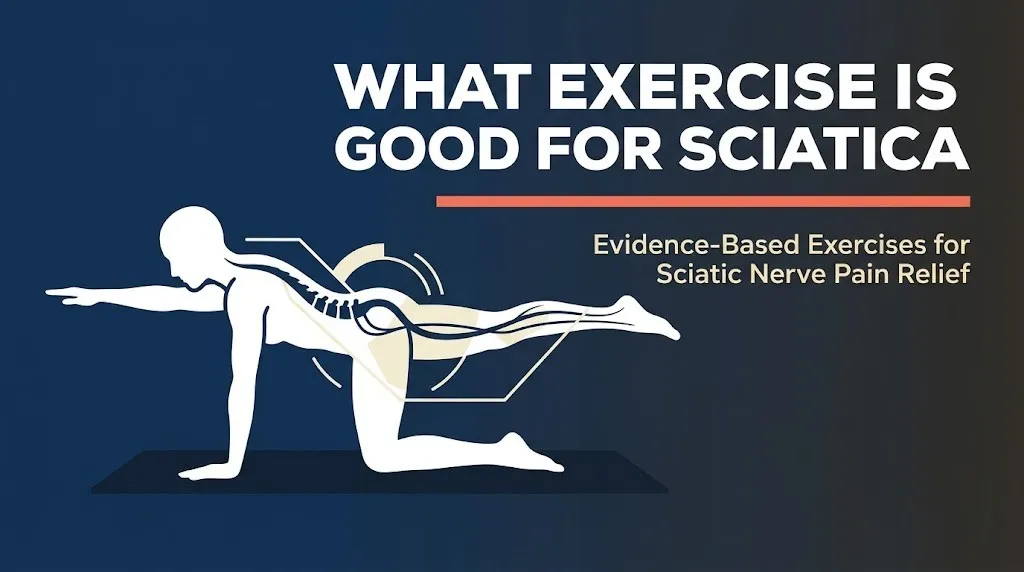
Movements that work best include gentle spinal extensions, hip stretches, lumbar stabilization exercises, and nerve mobilization techniques. These approaches reduce direct pressure on the nerve, improve circulation around the nerve root, and build the muscular support your spine needs to stay decompressed between sessions.
Not every exercise works the same way for every person, though. The cause of your sciatica matters enormously. A herniated disc responds best to extension-based movements. Piriformis syndrome responds best to hip external rotator stretches. Spinal stenosis often responds better to flexion-based work. That distinction shapes everything else in this guide.
| Sciatica Cause | Movement Direction That Usually Helps | Exercise Category |
|---|---|---|
| Herniated disc (L4-L5, L5-S1) | Extension (arching back) | McKenzie press-ups, prone lying |
| Piriformis syndrome | Hip external rotation stretch | Piriformis stretch, hip rotator work |
| Spinal stenosis | Flexion (bending forward) | Knee-to-chest, seated forward bend |
| General deconditioning | Stabilization and low-impact movement | Bird dog, bridge, walking |
What’s the Best Exercise for Sciatica Overall?
The bird dog exercise (also called the quadruped opposite arm and leg raise) consistently ranks as one of the most effective and safest exercises for sciatica across multiple sciatica presentations.
It simultaneously trains the multifidus and erector spinae (the muscles that stabilize each vertebra in your lumbar spine) and the gluteus maximus, without placing compressive load on irritated disc tissue. That combination is difficult to match with any single exercise.
A 2021 review in the Journal of Orthopaedic and Sports Physical Therapy found that lumbar stabilization programs, which include the bird dog as a core component, produced significant pain reduction and functional improvement in patients with lumbar radiculopathy (the clinical term for nerve root irritation that produces sciatica-like symptoms).
That said, no single exercise is universally “best” for every person. Your sciatica cause, fitness level, pain severity, and any co-existing health conditions all shape which exercises will help most. The bird dog works broadly because it’s low-risk, adaptable, and targets the exact muscular system that protects the sciatic nerve most directly.
Beginner modification: Perform arm-only extension or leg-only extension before combining both. Keep your lumbar spine neutral throughout. Do not rotate your hips toward the extended leg.
Skip this exercise temporarily if you’re in an acute flare-up where any spinal movement causes sharp radiating pain. Start with prone lying and nerve glides first.
How Exercise Helps the Sciatic Nerve
Exercise relieves sciatica by reducing disc pressure, improving blood flow to compressed nerve tissue, and strengthening the muscles that protect the lumbar spine from further compression.
Think of your spine like a bridge. The muscles running along either side are the cables holding the structure steady. When those cables are weak or asymmetrical, the central structure takes on more load than it’s designed to handle. Exercise restores that cable system.
At the tissue level, movement pumps synovial fluid into the spinal joints and drives nutrients into intervertebral disc tissue, which has very limited direct blood supply. According to the National Institutes of Health (NIH), prolonged inactivity actually slows disc recovery by restricting this nutrient exchange.
Nerve mobility also matters. The sciatic nerve is not a static structure. It needs to glide freely through surrounding tissue with every step, hip movement, and lumbar bend. When the nerve becomes adhered to surrounding fascia or compressed within a tight piriformis muscle, movement that mobilizes the nerve directly helps restore that gliding function.
The Cleveland Clinic notes that exercise increases endorphin production, which blunts the perception of neuropathic pain. That’s a real physiological effect, not just distraction.
Key Fact:
- Movement is consistently preferred over bed rest for sciatica, according to guidelines from both the ACSM and the NIH.
- Immobility beyond 2 to 3 days is associated with slower recovery and increased fear-avoidance behavior.
- Even gentle walking activates spinal stabilizers and encourages nerve gliding.
Key Takeaway: Exercise beats rest for sciatica recovery, and matching the exercise type to the specific cause of your sciatica is the difference between progress and prolonged pain.
Exercises for Sciatica Pain Relief: A Full List
The best set of exercises for sciatica pain relief combines nerve mobilization, spinal stabilization, hip flexibility, and low-impact movement.
No single exercise category does everything. Nerve glides address the mechanical restriction of the sciatic nerve. Stabilization exercises reduce spinal load. Stretches address muscular compression. Low-impact movement keeps circulation going and prevents the deconditioning that prolongs recovery.
Here is a structured overview of the primary categories and the best representative exercise from each:
| Exercise Category | Best Representative Exercise | Primary Target |
|---|---|---|
| Nerve mobilization | Sciatic nerve floss (neural glide) | Sciatic nerve mobility |
| Spinal stabilization | Bird dog (quadruped opposite arm-leg raise) | Multifidus, erector spinae |
| Hip flexibility | Supine piriformis stretch (figure-4 stretch) | Piriformis, external hip rotators |
| Lumbar extension | Prone press-up (McKenzie extension) | Lumbar disc and extensor muscles |
| Low-impact movement | Walking | Full-body circulation, nerve gliding |
| Core control | Dead bug exercise | Transverse abdominis, lumbar spine |
| Hip mobility | Supine knee-to-chest stretch | Lumbar flexors, hip flexors |
| Whole-body mobility | Cat-cow stretch (spinal flexion-extension mobilization) | Lumbar and thoracic spine |
Each of these exercises is covered in detail in the sections below. They are listed in approximate order of how a beginner should approach them: nerve gliding first, then stretching, then stabilization, then progressive strengthening.
Piriformis Stretch for Sciatica
The piriformis stretch (also called the supine figure-4 stretch or supine crossed-leg stretch) directly targets the piriformis muscle, which sits in the deep gluteal region and, when tight or inflamed, can press directly against the sciatic nerve as it exits the lumbar spine.
This stretch is particularly effective when sciatica originates from piriformis syndrome rather than a disc herniation. The two conditions feel similar from the outside but respond differently to treatment. If your pain is primarily in the buttock and radiates down the leg, with no centralization to the lower back, piriformis syndrome is a common culprit.
To perform the supine piriformis stretch:
- Lie on your back with both knees bent and feet flat on the floor.
- Cross your right ankle over your left knee, forming a figure-4 shape.
- Flex your right foot gently to protect the right knee.
- Either hold this position (passive stretch) or gently draw your left knee toward your chest until you feel a mild stretch in your right outer hip or buttock.
- Hold for 20 to 30 seconds. Breathe steadily throughout.
- Release slowly. Repeat on the opposite side.
- Perform 3 repetitions per side.
Beginner modification: Perform this stretch seated in a firm chair. Cross your right ankle over your left knee and gently lean forward from the hips (not the back) until you feel the stretch in the outer hip.
Important: Stop immediately if you feel sharp, electric, or worsening radiating pain down the leg. Mild tension in the hip is expected. Nerve-like sensation traveling toward the foot is not.
If you have had a recent hip replacement, check with your treating clinician before performing this stretch, as the range of motion involved may exceed safe post-surgical limits.
McKenzie Exercises for Sciatica
The McKenzie method is a set of directional movement techniques developed by physiotherapist Robin McKenzie, widely used for disc-related lower back pain and sciatica.
The core principle is “centralization”: moving symptoms from the leg back toward the lower back and ultimately eliminating them through repeated directional movements. Research published in Spine has found the McKenzie method to be effective at reducing pain and disability in people with lumbar disc herniation-related radiculopathy.
The most commonly used McKenzie exercise for sciatica is the prone press-up (also called the prone lumbar extension or McKenzie press-up extension):
To perform the prone press-up:
- Lie face down on a firm mat with your hands positioned under your shoulders, as if preparing for a push-up.
- Keep your hips, pelvis, and legs relaxed and in contact with the floor throughout the movement.
- Press up slowly with your arms, extending your lower back while your hips stay on the floor.
- Go only as far as you can without pain increasing in the leg. Some back pressure is acceptable.
- Hold the top position for 1 to 2 seconds.
- Lower back down slowly.
- Repeat for 10 repetitions, rest 1 minute, perform 2 to 3 sets.
Beginner modification (sphinx position): Begin by resting on your forearms rather than pressing up on your hands. Hold the forearm position for 30 to 60 seconds. This is less intensive and appropriate for those in the early stages of a flare.
Contraindication: This exercise is not appropriate for sciatica caused by spinal stenosis. Extension movements narrow the spinal canal and can worsen symptoms in that specific presentation. If you have a confirmed stenosis diagnosis, avoid this exercise and use flexion-based approaches instead.
Sciatic Nerve Gliding Exercises
The sciatic nerve floss (also called a sciatic neural glide or sciatic nerve gliding exercise) is a nerve mobilization technique designed to restore the sciatic nerve’s ability to slide freely through surrounding tissue.
The sciatic nerve must travel through several tight anatomical spaces: between lumbar vertebrae, through the gluteal region, and down through the thigh. When surrounding muscles or fascia become tight, the nerve loses its natural glide. Neural gliding exercises restore this movement by gently tensioning and releasing the nerve in a rhythmic pattern.
To perform the seated sciatic nerve floss:
- Sit upright on a chair with both feet flat on the floor.
- Straighten your right leg out in front of you, bringing the foot to a level position.
- As you extend the knee, flex your foot so toes point toward your shin (dorsiflexion). This creates tension in the nerve.
- Hold for 2 to 3 seconds at the top.
- Return the foot to the floor slowly. Repeat 10 times per side.
- For a more advanced floss, add a chin-tuck (gently tucking your chin to chest) as you extend the knee to add tension from above.
According to a 2019 review in the Journal of Orthopaedic and Sports Physical Therapy, neural mobilization techniques produced meaningful pain reduction compared to passive rest in patients with lumbar radiculopathy.
Beginner modification: Perform this exercise supine (lying on your back) instead of seated. Bend the knee to 90 degrees, then slowly straighten the knee only to the point of mild tension, not pain.
Modification for acute flares: During a severe flare, avoid neural tension positions entirely. Begin with pain-free movement, then introduce gentle gliding only when leg pain starts to improve.
Key Takeaway: Nerve gliding exercises address the mechanical restriction of the sciatic nerve itself, which stretching and strengthening alone do not fully resolve.
Core Exercises for Sciatica
Core exercises reduce sciatic nerve irritation by strengthening the deep spinal stabilizers that protect the lumbar vertebrae and intervertebral discs from mechanical stress.
The muscles most relevant here are the transverse abdominis (the deepest abdominal layer), the multifidus (small muscles that stabilize each vertebra individually), and the lumbar erector spinae. Weakness in this system forces the vertebrae to rely on passive structures like discs and ligaments for stability, increasing compression on nerve roots.
The dead bug exercise is one of the most effective core stabilization exercises for people with sciatica because it trains anti-extension control without loading the lumbar spine.
To perform the dead bug:
- Lie on your back with your arms extended toward the ceiling and both knees bent at 90 degrees, shins parallel to the floor (tabletop position).
- Press your lower back gently into the floor and hold it there throughout the movement.
- Slowly lower your right arm toward the floor overhead while simultaneously extending your left leg toward the floor, keeping it hovering a few inches above the surface.
- Stop before your lower back arches off the floor.
- Return both limbs to the start position in a slow, controlled manner.
- Repeat on the opposite side. That is one full repetition.
- Perform 3 sets of 8 to 10 repetitions.
Beginner modification: Lower one limb at a time instead of simultaneously. Start with arm-only lowering, then leg-only lowering, before combining them.
The American Council on Exercise (ACE) emphasizes that sciatica rehabilitation should prioritize spinal neutrality over range of motion in core training. Keep every repetition controlled and pain-free.
Do not attempt crunches, sit-ups, or heavy loaded core work during a sciatica flare-up. Those exercises increase intra-abdominal pressure and can worsen disc compression.
Hip Stretches for Sciatica
Hip stretches for sciatica target the muscles that surround and directly influence the sciatic nerve’s pathway: the piriformis, gluteus medius, hip flexors, and hip external rotators.
Tightness in any of these muscles increases the mechanical pull on the lumbar spine and pelvis, which shifts load onto intervertebral discs and alters the space through which the sciatic nerve passes. Regular hip stretching relieves that downstream tension.
Three hip stretches consistently supported by physical therapy practice for sciatica:
- Supine knee-to-chest stretch: Lie on your back, pull one knee gently toward your chest while the opposite leg stays extended on the floor. Hold 20 to 30 seconds per side. Targets hip flexors and lumbar flexors.
- Supine figure-4 piriformis stretch (described in detail above): Targets the piriformis and deep external hip rotators.
- Kneeling hip flexor stretch (half-kneeling lunge position): Kneel on one knee with the opposite foot forward, sink the hips gently forward until you feel a stretch in the front of the trailing hip. Hold 20 to 30 seconds. Targets the hip flexor (iliopsoas) on the rear leg side.
| Hip Stretch | Target Muscle | Position | Hold Time |
|---|---|---|---|
| Knee-to-chest | Lumbar flexors, hip flexors | Supine (lying on back) | 20 to 30 seconds |
| Figure-4 (piriformis) | Piriformis, external rotators | Supine (lying on back) | 20 to 30 seconds |
| Half-kneeling hip flexor | Iliopsoas, rectus femoris | Kneeling | 20 to 30 seconds |
Beginner modification: All three stretches can be performed on a bed or firm sofa for people who cannot get down to the floor comfortably. Reduce the hold time to 15 seconds initially and build from there.
Exercises for Sciatica from a Herniated Disc
Sciatica caused by a herniated disc responds best to lumbar extension-based exercises, which help move disc material away from the nerve root it is pressing against.
When a disc herniates posteriorly (which is the most common direction), it presses backward toward the spinal canal or nerve roots. Extension movements load the front of the disc and have a mechanical effect of shifting herniated material away from the posterior nerve root. This is the clinical rationale behind the McKenzie method described earlier.
The most effective exercise sequence for disc-related sciatica, from easiest to most demanding:
- Prone lying: Simply lying face down for 5 minutes encourages passive lumbar extension. Start here during acute phases.
- Prone resting on forearms (sphinx position): Gentle extension. Hold 30 to 60 seconds, repeat 3 to 4 times.
- Prone press-up (McKenzie extension): Full active extension. 10 reps, 2 to 3 sets.
- Standing lumbar extension: Stand with hands on lower back, gently arch backward. 10 reps, 2 to 3 sets.
- Bird dog: Adds stabilization component once initial pain subsides.
Research published in Spine has found that the McKenzie extension approach reduces pain and speeds functional recovery in patients with lumbar disc herniation more effectively than passive care alone.
Key caution: If extension increases leg pain (pain moves further down toward the foot), stop and work with a physical therapist to reassess. Centralization (pain moving toward the back) is a positive sign. Peripheralization (pain moving away from the back, further into the leg) is a warning sign.
People with spondylolisthesis (vertebral slippage) should have a spinal assessment before pursuing extension-based exercises. Extension can be contraindicated in that presentation.
Key Takeaway: Herniated disc sciatica generally responds to extension exercises, while spinal stenosis sciatica responds to flexion movements. Getting that direction right is the single most important variable in sciatica exercise selection.
Exercises for Sciatica from Spinal Stenosis
Sciatica from spinal stenosis (narrowing of the spinal canal) responds to lumbar flexion-based exercises, which temporarily open the spinal canal and reduce pressure on affected nerve roots.
This is the opposite direction from disc herniation exercises, which is why cause-specific guidance matters so much. A person with stenosis who performs McKenzie extension exercises may experience a flare because extension reduces the already narrowed canal space.
Effective exercises for stenosis-related sciatica include:
- Supine knee-to-chest stretch: Draw both knees to the chest simultaneously to flatten and decompress the lumbar spine. Hold 20 to 30 seconds, repeat 5 to 8 times.
- Seated lumbar flexion: Sit in a chair, feet flat on the floor. Gently lean forward, letting your chest drop toward your thighs. Feel the lower back round and open. Hold 10 to 15 seconds.
- Pelvic tilt: Lie on your back with knees bent, feet flat. Gently flatten your lower back against the floor by tilting the pelvis upward. Hold 5 seconds. Release. Repeat 10 to 15 times. This activates the transverse abdominis and reduces lumbar lordosis (the inward curve).
- Stationary cycling: The seated, slightly forward-flexed position on a stationary bike opens the spinal canal. It is one of the most tolerable aerobic exercises for people with stenosis.
The Mayo Clinic notes that people with spinal stenosis often find they can walk or exercise more comfortably when slightly bent forward (such as pushing a grocery cart), which is the same biomechanical principle behind flexion-based exercise selection.
Modification for severe stenosis: Begin all exercises in a pain-free range. Avoid prolonged standing or walking without a rest break. Work with a physical therapist to determine a safe weekly progression timeline before adding strengthening exercises.
Walking for Sciatica Relief
Walking is one of the most effective and accessible exercises for sciatica, promoting nerve gliding, spinal decompression, and endorphin release without excessive impact on the lumbar spine.
Every step you take generates a gentle rhythmic movement through the lumbar spine, which encourages the sciatic nerve to glide through its surrounding tissue. That natural gliding action, repeated across hundreds of steps, is essentially a prolonged low-intensity nerve mobilization session.
Walking also activates the gluteus medius and gluteus maximus, hip stabilizers that directly influence pelvic alignment and reduce lateral shear on the lumbar vertebrae. Weak glutes are a contributing factor in many sciatica cases.
The question is how much walking and at what pace. Research suggests starting conservatively:
| Phase | Daily Walking Goal | Pace | Surface |
|---|---|---|---|
| Acute flare (days 1 to 3) | 5 to 10 minutes, as tolerated | Slow, pain-free pace | Flat, even surface |
| Early recovery (week 1 to 2) | 15 to 20 minutes | Comfortable, conversational | Flat or slight incline |
| Building phase (week 3 to 6) | 30 minutes | Moderate | Variable surface acceptable |
| Maintenance | 30 to 45 minutes most days | Brisk but pain-free | Any comfortable surface |
Stop walking and rest if leg pain increases significantly during or after a session. Mild back stiffness that resolves within 30 minutes is generally acceptable. Leg pain that worsens or radiates further is a signal to back off and reassess.
Modification for severe flares: Use a walking stick or trekking poles temporarily to reduce spinal load and maintain an upright posture. This can allow earlier return to walking for people who find the standard upright posture aggravating.
Yoga for Sciatic Nerve Pain
Yoga can reduce sciatic nerve pain through a combination of spinal mobility, hip stretching, and core activation, provided that poses are chosen carefully based on the type of sciatica.
Not all yoga poses are appropriate for sciatica. Forward folds and seated twists can be helpful or harmful depending on whether your sciatica is disc-driven or stenosis-driven. The goal is to select poses that match your movement direction and avoid positions that provoke or increase leg symptoms.
Yoga poses that are broadly supported for most sciatica presentations:
- Child’s pose (balasana): Gently decompresses the lumbar spine. Particularly helpful for stenosis-related sciatica.
- Reclined pigeon pose (supta kapotasana): A supine version of pigeon pose that stretches the piriformis without the compressive loading of the seated version.
- Sphinx pose: A gentle lumbar extension. Helpful for disc-related sciatica.
- Cat-cow stretch (spinal flexion-extension mobilization): Alternates lumbar flexion and extension, improving spinal mobility and fluid exchange in the discs.
- Supine spinal twist (supta matsyendrasana): Gentle rotation with low spinal load. Perform with caution and stop if leg symptoms increase.
According to a 2017 review published in the Annals of Internal Medicine, yoga produced comparable pain reduction to physical therapy for chronic low back pain conditions. While that study was broader than sciatica specifically, the spinal stabilization and flexibility principles apply.
Beginner modification: Take a restorative or gentle yoga class rather than vinyasa or power yoga. Chair yoga is appropriate for people with limited floor mobility.
Who should approach yoga cautiously: People with severe disc herniation, active radiculopathy (pain below the knee), or recent spinal surgery should confirm with their treating clinician that yoga movements are appropriate before starting.
Key Takeaway: Yoga can genuinely help sciatica when the right poses are selected, but it requires cause-specific selection. A pigeon pose that helps one person may significantly worsen another’s symptoms depending on their diagnosis.
Sciatica Exercises to Avoid
Several exercises consistently worsen sciatica by increasing disc compression, narrowing the spinal canal, or placing excessive tension on an already irritated sciatic nerve.
Understanding why these movements are problematic is more useful than a simple list. The mechanics behind each one help you make smarter decisions when you encounter similar movements.
Exercises to avoid with sciatica, with reasons:
- Full sit-ups and crunches: Load the lumbar spine in flexion with significant intra-abdominal pressure. Increase force on posterior disc tissue. Can worsen disc herniation-related nerve compression.
- Straight-leg deadlifts (stiff-leg deadlifts): Place maximum neural tension on the sciatic nerve through simultaneous spinal flexion and knee extension. Even with a herniated disc, this movement at heavy loads is high risk.
- Heavy barbell squats (during acute flare): Compressive spinal loading combined with the depth of a full squat is too demanding when a nerve root is actively irritated.
- Leg presses with a deep range of motion: Forces the lumbar spine into flexion under load. Similar mechanical risk to the full squat.
- High-impact running or jumping: Impact forces transmitted through the spine can aggravate an already irritated nerve root. Wait until acute symptoms resolve before returning.
- Seated forward folds with straight legs (for disc-related sciatica): Increases sciatic nerve tension. May help stenosis-related sciatica but is generally not appropriate during an active disc herniation flare.
| Exercise | Why It Worsens Sciatica | Alternative |
|---|---|---|
| Full sit-ups | Lumbar flexion under load | Dead bug exercise |
| Straight-leg deadlift | Maximum sciatic nerve tension | Romanian deadlift with bent knee |
| Heavy squats (acute flare) | Compressive spinal load | Body weight or assisted squat |
| High-impact running | Spinal impact during nerve irritation | Walking, cycling, swimming |
| Seated forward fold (disc sciatica) | Peripheralizes sciatic symptoms | Prone press-up instead |
How Many Times a Day Should You Do Sciatica Exercises?
Most sciatica exercises should be performed 2 to 3 times per day during the recovery phase, with each session lasting 10 to 20 minutes.
That frequency recommendation comes from how the sciatic nerve and spinal tissues respond to movement. Unlike muscle training, where you need 48 hours of recovery between sessions, nerve mobilization and gentle stabilization exercises benefit from frequent, low-volume repetition throughout the day. Short sessions repeated multiple times are more effective than one long session.
Here is a practical daily framework based on standard physical therapy protocols:
| Time of Day | Exercise Type | Duration |
|---|---|---|
| Morning (after waking) | Nerve glides + hip stretches | 10 minutes |
| Midday (especially after prolonged sitting) | Piriformis stretch + pelvic tilt | 5 to 10 minutes |
| Evening | Core stabilization (bird dog, dead bug) + walking | 20 to 30 minutes |
During an acute flare, reduce the intensity of each session but maintain the frequency. Three short, gentle sessions of 5 minutes each are more beneficial than skipping movement entirely and doing one 30-minute session.
According to clinical guidelines supported by the American College of Sports Medicine (ACSM), people recovering from lumbar radiculopathy should aim to move gently and frequently rather than alternating between prolonged rest and intense exercise bouts.
Progression rule: When you complete a session with zero increase in leg symptoms for 5 consecutive days, you are ready to add one additional exercise or increase repetitions. Never increase both volume and intensity in the same week.
When to reduce frequency: If any session causes leg symptoms to increase and those symptoms do not return to baseline within 2 hours, reduce frequency and consult a physical therapist to review your exercise selection.
Best Exercises for Sciatica at Home
The most effective at-home sciatica exercise routine combines nerve gliding, hip stretching, lumbar stabilization, and daily walking, all without any equipment.
One of the most common misconceptions is that effective sciatica recovery requires gym access or specialized equipment. The exercises with the strongest evidence base for sciatica (nerve flossing, bird dog, piriformis stretch, prone press-up) require only a firm mat or carpet and enough floor space to lie down fully.
Here is a complete beginner-to-intermediate at-home sciatica exercise program:
Week 1 to 2 (Foundation Phase):
- Prone lying: 5 minutes each morning.
- Supine knee-to-chest stretch: 3 repetitions per side, hold 20 seconds.
- Seated sciatic nerve floss: 10 repetitions per side.
- Supine piriformis stretch: 3 repetitions per side, hold 20 to 30 seconds.
- Short walk: 10 to 15 minutes at a comfortable pace.
Week 3 to 4 (Building Phase):
- Prone press-up: 10 repetitions, 2 sets (disc-related sciatica only).
- Pelvic tilt: 15 repetitions.
- Bird dog: 8 repetitions per side, 2 sets.
- Dead bug: 8 repetitions per side, 2 sets.
- Walk: 20 to 30 minutes.
Week 5 onward (Maintenance Phase):
Add the bridge exercise (glute bridge): Lie on your back, knees bent, feet flat. Press through your heels to lift your hips toward the ceiling. Squeeze your glutes at the top. Lower slowly. This strengthens the gluteus maximus and hamstrings, reducing chronic load on the lumbar spine.
Quick Tip:
- Set a timer on your phone for every 30 minutes of sitting. Stand, do 5 sciatic nerve floss repetitions, and take a 2-minute walk.
- Place your mat near your bed so morning exercises feel immediate, not effortful.
- Track pain location each day: if symptoms centralize (move toward the back), your program is working.
Key Takeaway: A complete at-home sciatica exercise program costs nothing and requires no equipment. Consistency across multiple short daily sessions beats one intense weekly workout every time.
Frequently Asked Questions About Sciatica Exercises
What is the single best exercise for sciatica pain relief?
The bird dog exercise (quadruped opposite arm and leg raise) is widely considered the most broadly effective exercise for sciatica across different causes.
It strengthens the deep spinal stabilizers without compressing the lumbar spine or placing excessive tension on the sciatic nerve.
For disc-related sciatica specifically, the McKenzie prone press-up is often the more targeted first choice.
Can exercise make sciatica worse?
Yes, the wrong exercises or too much intensity too soon can worsen sciatica symptoms.
High-impact movements, heavy loaded spinal flexion, and exercises that provoke radiating leg pain should be avoided until acute symptoms settle.
If leg pain increases during or after exercise and does not return to its starting level within 2 hours, reduce intensity and review your exercise selection with a physical therapist.
How long does it take for sciatica exercises to work?
Most people notice a meaningful reduction in symptoms within 4 to 6 weeks of consistent daily exercise.
Acute disc-related sciatica often improves faster than chronic or stenosis-related sciatica, which may take 8 to 12 weeks of progressive exercise to produce sustained relief.
Research published in Spine suggests that patients who exercise consistently from the early stages of sciatica recover faster than those who rest and wait.
Should I rest or exercise when sciatica is flaring up?
Gentle movement is generally preferred over complete rest, even during a flare-up.
The NIH advises limiting bed rest to no more than 1 to 2 days during acute episodes, then returning to low-intensity movement like walking and nerve gliding.
If pain is severe enough that any movement increases leg symptoms, confirm with a treating clinician that your current symptoms do not require imaging or medical management before continuing exercise.
What exercises should I completely avoid with sciatica?
Avoid full sit-ups, straight-leg deadlifts, heavy barbell squats during acute phases, and high-impact running or jumping until leg symptoms resolve.
Seated forward folds with straight legs should also be avoided if your sciatica is disc-related, as this position significantly increases sciatic nerve tension.
Replace these movements with their lower-risk alternatives: dead bug instead of crunches, walking instead of running, and body weight squats instead of loaded squats during recovery.
The Straightforward Summary
Start with the basics: nerve gliding, hip stretching, and gentle core work. Do them 2 to 3 times per day in short sessions rather than one long push. Match your exercise direction to your sciatica cause. Extension for disc herniation, flexion for stenosis, external hip rotation work for piriformis syndrome.
If symptoms worsen or move further down the leg during exercise, that is your signal to pause and reassess. Progress that moves pain toward your back and out of your leg is the goal.
The research is consistent. Movement, done correctly and consistently, is what gets people through sciatica faster than anything else.