
The average person burns between 1,600 and 3,000 calories per day without any intentional exercise, depending on their body size, age, sex, and daily movement habits. Most of that burn happens quietly in the background, keeping your heart beating, your lungs expanding, and your cells running.
This matters more than most people realize. According to the National Institutes of Health, resting and non-exercise energy expenditure accounts for the majority of the calories most sedentary adults burn each day. That means what happens outside the gym often shapes your energy balance more than what happens inside it.
This article breaks down every component of your daily calorie burn: what BMR and TDEE actually mean, how your body weight, age, sex, and muscle mass affect the numbers, and which everyday habits quietly raise or lower your total burn without a single workout.
How Many Calories Does the Average Person Burn a Day Without Exercise?
Most adults burn somewhere between 1,600 and 3,000 calories per day without structured exercise, though the actual range varies widely based on individual factors.
A sedentary adult woman in her 30s weighing around 150 pounds typically burns between 1,400 and 1,800 calories per day. A sedentary adult man in his 30s weighing around 190 pounds typically burns between 1,800 and 2,400 calories per day. These figures include resting metabolism, daily movement, and digestion but exclude intentional workouts.
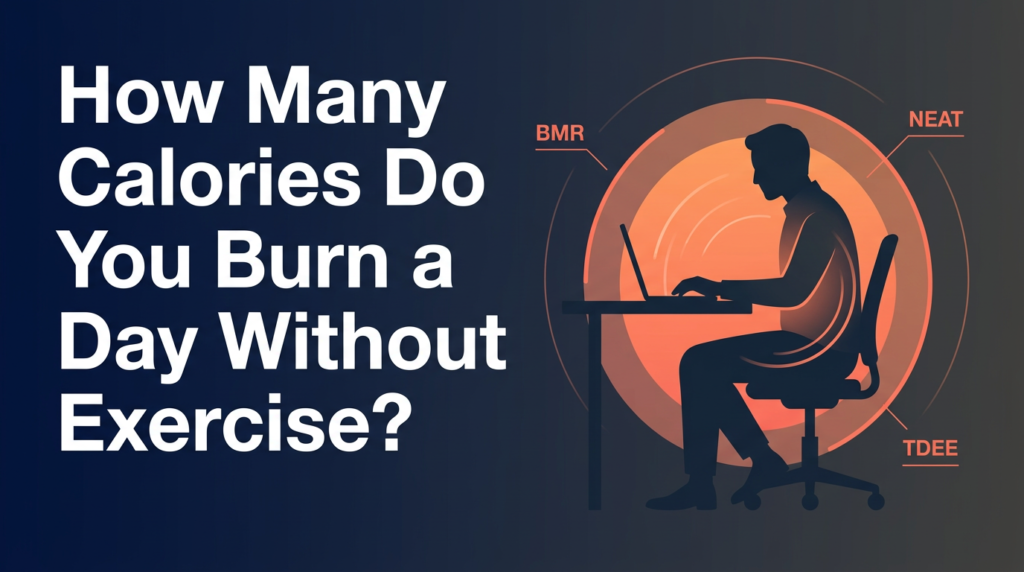
The number is not fixed. It shifts based on how much you weigh, how old you are, what you’re made of (muscle versus fat), and even how much you fidget. Two people of identical height and weight can have daily calorie burns that differ by 200 to 300 calories based on body composition and lifestyle habits alone.
Reference ranges for daily calorie burn without exercise:
| Group | Approximate Daily Calorie Burn |
|---|---|
| Sedentary adult women (18 to 39) | 1,400 to 1,900 kcal |
| Sedentary adult men (18 to 39) | 1,800 to 2,400 kcal |
| Sedentary adult women (40 to 59) | 1,300 to 1,750 kcal |
| Sedentary adult men (40 to 59) | 1,700 to 2,200 kcal |
| Sedentary adults (60 and over) | 1,200 to 1,800 kcal |
These ranges are based on Mifflin-St Jeor equation estimates combined with a sedentary activity multiplier (1.2), which is the method recommended by the American College of Sports Medicine for estimating resting plus low-activity calorie needs.
What Is Basal Metabolic Rate and How Many Calories Does It Burn?
Basal metabolic rate (BMR) is the number of calories your body burns at complete rest to keep vital functions running: breathing, circulation, cell repair, and temperature regulation.
BMR is the largest single piece of your daily calorie burn. For most sedentary adults, it accounts for 60 to 70 percent of total daily energy expenditure. Think of it like the idle speed of a car engine: even parked, the engine uses fuel just to run.
Your BMR is determined primarily by your lean body mass (the weight of everything in your body that is not fat), your age, your height, and your sex. Larger bodies with more muscle tissue have higher BMRs because more cells require more energy to maintain.
According to the Mayo Clinic, the Mifflin-St Jeor equation is currently the most accurate formula for estimating BMR in most adults:
- For men: BMR = (10 x weight in kg) + (6.25 x height in cm) – (5 x age) + 5
- For women: BMR = (10 x weight in kg) + (6.25 x height in cm) – (5 x age) – 161
A 35-year-old woman who is 5’5″ (165 cm) and weighs 145 pounds (65.8 kg) has an estimated BMR of approximately 1,427 calories per day. That is what she burns before getting out of bed, eating anything, or walking to the bathroom.
Quick Tip:
- BMR is not the same as how many calories you should eat. It’s just the floor.
- Your actual calorie needs are always higher than your BMR because daily life adds more burn on top.
- BMR calculators are estimates. Individual variation exists due to genetics, hormone levels, and body composition.
What Is Total Daily Energy Expenditure (TDEE)?
Total daily energy expenditure (TDEE) is the total number of calories your body burns in a full day, including your BMR plus everything else you do.
TDEE has four named components. Understanding each one separately helps clarify why two people with the same BMR can still have very different daily calorie burns.
The four components of TDEE are:
- BMR (Basal Metabolic Rate): Calories burned at complete rest. Accounts for 60 to 70 percent of TDEE in sedentary adults.
- NEAT (Non-Exercise Activity Thermogenesis): Calories burned through all movement that is not intentional exercise: walking, fidgeting, cooking, typing, and standing. Accounts for 15 to 30 percent of TDEE and varies most between individuals.
- TEF (Thermic Effect of Food): Calories burned digesting and processing food. Accounts for roughly 8 to 15 percent of TDEE.
- EAT (Exercise Activity Thermogenesis): Calories burned during intentional exercise. In non-exercising adults, this is essentially zero.
A study published in the journal Obesity found that NEAT alone can vary by up to 2,000 calories per day between individuals of similar body size. That is not a small variation. It helps explain why some people seem to “eat whatever they want” without gaining weight while others struggle at the same intake.
| TDEE Component | Contribution in Sedentary Adults | Primary Drivers |
|---|---|---|
| BMR | 60 to 70% | Lean body mass, age, sex, height |
| NEAT | 15 to 30% | Daily movement, occupation, habits |
| TEF | 8 to 15% | Dietary composition, meal size |
| EAT | 0 to 5% | Exercise type, duration, intensity |
For a sedentary adult, TDEE is typically calculated as BMR multiplied by 1.2. For a lightly active adult (light movement most days), the multiplier rises to 1.375.
Key Takeaway: Your daily calorie burn without exercise is made up of four distinct parts. BMR is the biggest, but NEAT is the most variable, and it differs by up to 2,000 calories per day between people of the same size.
How to Calculate How Many Calories You Burn Per Day
Calculating your daily calorie burn starts with estimating your BMR using the Mifflin-St Jeor equation, then multiplying by your activity level.
To calculate your TDEE:
- Convert your weight to kilograms (divide pounds by 2.205).
- Convert your height to centimeters (multiply inches by 2.54).
- Plug your numbers into the Mifflin-St Jeor formula for your sex.
- Multiply the resulting BMR by your activity factor.
- The result is your estimated TDEE for the day.
Activity multipliers used in clinical settings:
| Activity Level | Description | Multiplier |
|---|---|---|
| Sedentary | Desk job, little to no movement | 1.2 |
| Lightly active | Walking or light work most days | 1.375 |
| Moderately active | Active work or exercise 3 to 5 days/week | 1.55 |
| Very active | Physical job or hard training 6 to 7 days/week | 1.725 |
| Extremely active | Physical labor plus daily intense training | 1.9 |
For a 40-year-old man who is 5’10” (178 cm), weighs 180 pounds (81.6 kg), and is sedentary:
BMR = (10 x 81.6) + (6.25 x 178) – (5 x 40) + 5 = 816 + 1112.5 – 200 + 5 = 1,733.5 calories
TDEE = 1,733.5 x 1.2 = approximately 2,080 calories per day
Keep in mind that these calculations are estimates. The American College of Sports Medicine notes that even the most accurate prediction equations carry a margin of error of 10 to 15 percent in healthy adults. Indirect calorimetry testing, available at some sports medicine clinics, provides a more precise measurement.
What Is NEAT (Non-Exercise Activity Thermogenesis)?
NEAT, or non-exercise activity thermogenesis, is the energy your body uses for every movement that is not sleeping, eating, or intentional exercise.
NEAT includes walking to your car, fidgeting in your chair, doing dishes, taking the stairs, standing at a counter, or even gesturing while you talk. It sounds trivial. The research says otherwise.
A landmark study by Dr. James Levine at the Mayo Clinic, published in Science, found that obese individuals sit an average of 2.5 hours more per day than lean individuals. The difference in NEAT between the two groups accounted for approximately 350 calories per day, a gap large enough to drive meaningful weight differences over time.
Key points about NEAT:
- It is the most variable component of TDEE between individuals.
- Occupation is a major driver: a construction worker has dramatically higher NEAT than an office worker of the same weight.
- NEAT decreases significantly during weight loss because the body becomes lighter and movement requires less energy.
- Intentionally increasing NEAT is one of the most sustainable ways to raise daily calorie burn without formal exercise.
NEAT is why a waiter and a software developer of the same height and weight can have daily calorie burns that differ by 500 calories or more, despite neither one visiting a gym.
How Many Calories Does a Sedentary Person Burn Per Day?
A sedentary adult burns approximately 1,400 to 2,400 calories per day, depending on their body size and other individual factors.
The term “sedentary” has a clinical definition in energy expenditure research. It refers to someone who moves very little beyond the basic activities of daily life: sitting at a desk most of the day, minimal walking, no intentional exercise. An activity multiplier of 1.2 is applied to their BMR to estimate TDEE.
That does not mean they are burning nothing beyond BMR. Even a sedentary person walks to the bathroom, chews food, shifts in their chair, and digests meals. These small actions add up to the 20 percent extra that the 1.2 multiplier represents.
Estimated daily calorie burn for sedentary adults by body weight:
| Body Weight | Sedentary Woman (35 years old) | Sedentary Man (35 years old) |
|---|---|---|
| 130 lbs (59 kg) | ~1,450 kcal/day | ~1,700 kcal/day |
| 155 lbs (70 kg) | ~1,600 kcal/day | ~1,850 kcal/day |
| 180 lbs (82 kg) | ~1,750 kcal/day | ~2,000 kcal/day |
| 210 lbs (95 kg) | ~1,950 kcal/day | ~2,200 kcal/day |
| 240 lbs (109 kg) | ~2,100 kcal/day | ~2,400 kcal/day |
Estimates are based on the Mifflin-St Jeor equation with a sedentary multiplier of 1.2. Individual variation applies.
If your goal is weight management without exercise, understanding this baseline is the starting point, not the endpoint. Your dietary intake relative to this number is what creates a caloric surplus or deficit over time.
Key Takeaway: A sedentary person still burns between 1,400 and 2,400 calories daily through basic body functions and minimal movement. Body weight is the strongest predictor of where in that range you fall.
How Does Body Weight Affect Daily Calorie Burn?
Body weight is one of the strongest predictors of how many calories you burn per day, because larger bodies require more energy to maintain.
Every additional pound of body mass means more cells, more tissue, and more biological work required to keep that mass alive and functional. According to research reviewed by the National Institutes of Health, for every additional 22 pounds (10 kg) of body weight, BMR increases by roughly 70 to 100 calories per day in adults of similar age and sex.
This creates an important reality for weight loss. As a person loses weight, their BMR drops. The same deficit that produced weight loss early in a diet will produce slower loss later, because the lighter body burns fewer calories at rest. This is sometimes called metabolic adaptation, and it is real and measurable.
Body composition matters too, not just total weight:
- Muscle tissue burns approximately 6 calories per pound per day at rest.
- Fat tissue burns approximately 2 calories per pound per day at rest.
- Two people weighing 180 pounds, one with 30% body fat and one with 15% body fat, can differ by 100 to 150 calories per day in BMR.
This is why resistance training is often recommended during weight loss phases. Preserving or building muscle protects your resting metabolic rate as your overall body weight decreases.
How Does Age Affect Metabolism and Calorie Burn?
Metabolism slows with age, and the change is measurable from your 30s onward, though the rate of decline is more gradual than most people expect.
A large study published in Science in 2021, which analyzed data from 6,400 people across 29 countries using the doubly labeled water method (considered the gold standard for measuring real-world energy expenditure), found that total daily energy expenditure remains relatively stable from ages 20 to 60. After age 60, metabolic rate declines by approximately 0.7 percent per year.
This challenges the popular belief that metabolism crashes in your 30s or 40s. The researchers found the biggest metabolic shifts occur in infancy and after age 60. Much of the middle-age “metabolic slowdown” appears to be driven by muscle loss (sarcopenia) rather than aging itself.
The practical takeaway:
- Preserving muscle mass through resistance training significantly reduces age-related metabolic slowdown.
- Hormonal changes (declining testosterone in men, declining estrogen in women at menopause) do influence body composition and may reduce BMR indirectly through muscle loss.
- The National Academy of Sports Medicine recommends that adults over 50 prioritize protein intake and resistance-based activity to counteract sarcopenia’s effect on resting metabolism.
| Age Range | Approximate Metabolic Change |
|---|---|
| 20 to 40 | Stable, with gradual small decline |
| 40 to 60 | Minimal decline (largely composition-driven) |
| 60 to 80 | ~0.7% annual decline in total energy expenditure |
| 80+ | More pronounced decline, compounded by inactivity |
How Do Men and Women Differ in Daily Calorie Burn?
Men generally burn more calories per day than women of the same age, height, and weight, primarily because men tend to carry more lean muscle mass.
The difference is not arbitrary. Testosterone promotes muscle development and maintenance, which raises resting metabolic rate. Men also tend to have lower body fat percentages than women of similar body weight, meaning more of their mass is metabolically active tissue.
The Mifflin-St Jeor equation accounts for this with a simple adjustment: +5 for men, -161 for women, after all other calculations. For two 35-year-olds at the same height and weight, this translates to a difference of approximately 166 calories per day in BMR before activity is factored in.
Key sex-based differences in daily calorie burn:
- Men have on average 10 to 15 percent higher BMR than women of equal height and weight.
- Women experience significant hormonal fluctuations throughout the menstrual cycle. Research in the American Journal of Physiology found that resting metabolic rate can vary by up to 8 percent across cycle phases, peaking during the luteal phase.
- Menopause reduces estrogen, which can lead to a loss of muscle mass and a corresponding drop in BMR of 5 to 10 percent over several years if lifestyle is unchanged.
- Men tend to store more visceral fat with age, which does not affect metabolic rate significantly but does raise other metabolic risk factors.
These differences are averages. Individual variation within each sex is large enough that some women burn more calories daily than many men.
Key Takeaway: Men typically burn 10 to 15 percent more calories than women of the same size because of higher muscle mass. But for both sexes, body composition matters more than sex alone.
Does Muscle Mass Affect How Many Calories You Burn at Rest?
Muscle tissue burns more calories at rest than fat tissue, making body composition a meaningful driver of your daily calorie burn.
Skeletal muscle is metabolically active. It uses energy continuously to maintain its structure, support protein synthesis, and respond to hormonal signals. Fat tissue requires far less energy to maintain, which is why two people at identical body weights but different muscle-to-fat ratios can have noticeably different resting calorie burns.
Research published in the Journal of Applied Physiology estimated that skeletal muscle accounts for approximately 20 to 25 percent of total resting energy expenditure in the average adult. This is substantial given that muscle represents only 40 to 50 percent of body mass in most healthy adults.
A practical breakdown:
- Adding 10 pounds of muscle through resistance training increases BMR by roughly 50 to 70 calories per day, based on estimates from exercise physiology literature.
- This is a real but modest effect. Muscle does not turn your body into a dramatically different furnace overnight.
- The larger benefit of muscle is that it supports higher activity-level calorie burn because strong muscles allow more intense movement with less fatigue.
People who have experienced significant muscle loss due to illness, long-term bed rest, or extreme caloric restriction will have a measurably lower BMR than their body weight alone would predict. This is one reason why crash diets can result in a reduced daily calorie burn that persists even after the diet ends.
Thermic Effect of Food and How Many Calories Digestion Burns
The thermic effect of food (TEF) refers to the calories your body uses to digest, absorb, and process the food you eat.
TEF is real calorie burn. Every meal you eat triggers enzymatic activity, gut motility, and metabolic processing that collectively burn energy. On average, TEF accounts for 8 to 15 percent of total daily energy expenditure.
The important detail: not all macronutrients have the same thermic cost.
| Macronutrient | Thermic Effect (% of calories consumed) |
|---|---|
| Protein | 20 to 30% |
| Carbohydrates | 5 to 10% |
| Dietary fat | 0 to 3% |
According to a study published in the Journal of the Academy of Nutrition and Dietetics, high-protein meals produce a measurably greater thermic response than meals of equivalent calorie content from fat or carbohydrates. Eating 200 calories of chicken breast burns approximately 40 to 60 of those calories through digestion alone. Eating 200 calories of olive oil burns fewer than 6.
Practical implications:
- Higher protein intake increases daily calorie burn slightly through TEF.
- More frequent meals do not consistently raise total TEF. Research indicates that total daily protein and food volume, not meal timing or frequency, drive most of TEF.
- Processed foods tend to have a lower thermic effect than whole foods of similar caloric value, because they require less digestive work.
TEF is not a weight loss shortcut on its own, but it is a real metabolic lever that most people overlook when estimating daily calorie burn.
Key Takeaway: Digestion burns real calories, and protein triggers the highest thermic response of any macronutrient. Eating more protein is one of the few dietary changes that directly increases daily calorie burn.
Does Sleep Affect How Many Calories You Burn?
Sleep affects daily calorie burn in two distinct ways: the calories burned during sleep itself, and the impact of sleep quality on waking metabolism.
The body does not shut down metabolically during sleep. Your brain, heart, immune system, and cellular repair processes all require energy. Most people burn approximately 0.4 to 0.5 calories per pound of body weight per hour during sleep. A 170-pound person sleeping 8 hours burns roughly 540 to 680 calories during that time.
The second effect is more consequential. Sleep deprivation disrupts the hormones that regulate metabolism:
- Ghrelin (the hunger-stimulating hormone) rises with poor sleep.
- Leptin (the satiety hormone) falls with poor sleep.
- Cortisol (a stress hormone) rises, promoting fat storage and muscle breakdown.
- Growth hormone, which supports muscle maintenance and repair, is primarily released during deep sleep and drops sharply with poor sleep quality.
A study published in the Annals of Internal Medicine found that adults on a caloric deficit who slept 5.5 hours per night lost significantly less fat mass and more lean muscle mass than those sleeping 8.5 hours, despite identical calorie intake. Poor sleep effectively shifts the body toward burning muscle instead of fat.
Getting 7 to 9 hours of quality sleep, as recommended by the American Academy of Sleep Medicine, is one of the most overlooked strategies for supporting healthy daily metabolism.
How Does Thyroid Health Affect Your Daily Calorie Burn?
The thyroid gland plays a central role in regulating metabolic rate. When it underperforms, daily calorie burn drops measurably.
The thyroid produces hormones T3 (triiodothyronine) and T4 (thyroxine), which regulate how quickly cells convert nutrients into energy. An underactive thyroid, known as hypothyroidism, slows this process. According to the American Thyroid Association, hypothyroidism affects approximately 5 percent of people in the United States, with women over 60 at the highest risk.
In people with untreated hypothyroidism:
- BMR can be reduced by 10 to 30 percent compared to people with normal thyroid function.
- Weight gain occurs even without changes in diet or activity.
- Cold intolerance, fatigue, and slower heart rate are common accompanying signs.
- Standard BMR calculators will consistently overestimate calorie burn because they do not account for thyroid status.
This matters for anyone who suspects their daily calorie burn does not match what standard calculators predict. If someone is eating at what should be a caloric deficit based on their estimated TDEE but is not losing weight, thyroid function is one of several medical factors worth discussing with a clinician who can order appropriate testing.
Other hormonal conditions that reduce daily calorie burn include polycystic ovary syndrome (PCOS), Cushing’s syndrome, and significant insulin resistance. These conditions influence body composition, cortisol levels, and cellular energy use in ways that standard formulas cannot capture.
NEAT Activities That Burn the Most Calories Without Exercise
NEAT activities are the non-exercise movements in your daily life, and some of them burn considerably more calories than most people expect.
Standing burns roughly 40 to 60 more calories per hour than sitting, according to research published in the European Journal of Preventive Cardiology. That is not enormous in isolation, but a person who stands for 4 extra hours per day burns an additional 160 to 240 calories without a single structured workout.
Estimated NEAT calorie burn for common daily activities:
| Activity | Approximate Calories/Hour (150 lb person) |
|---|---|
| Sitting still | 60 to 80 kcal |
| Standing | 100 to 130 kcal |
| Walking slowly (2 mph) | 180 to 210 kcal |
| Light housework (cleaning, tidying) | 150 to 200 kcal |
| Grocery shopping | 130 to 160 kcal |
| Fidgeting (moderate, throughout day) | 100 to 300 kcal (across full day) |
| Cooking | 100 to 140 kcal |
| Childcare (active) | 200 to 250 kcal |
Fidgeting deserves special mention. Research by Dr. Levine at the Mayo Clinic found that habitual fidgeters burn up to 300 extra calories per day compared to non-fidgeters of similar body size. Some of this appears to be innate, but deliberate strategies like standing while on calls, pacing during meetings, and taking walking breaks all contribute.
The cumulative effect of NEAT decisions over a full year can make a difference of 10 to 30 pounds of body weight without any formal exercise program, based on research modeling published in the International Journal of Obesity.
Key Takeaway: NEAT, the calories burned through everyday movement, is the most controllable part of your daily energy burn. Small daily habits like standing more, walking on calls, and doing light housework add up to hundreds of extra calories burned per week.
How to Increase Calorie Burn Without Exercising
Increasing your daily calorie burn without formal exercise is achievable through intentional changes to body composition, daily movement patterns, and dietary habits.
The most effective strategies:
1. Build and preserve lean muscle mass.
Even moderate resistance training (2 days per week) builds metabolically active tissue that raises BMR at rest. For non-exercisers who are genuinely unable to do formal workouts, daily bodyweight movements like standing, slow walking, and stair use still preserve muscle better than complete inactivity.
2. Increase your NEAT deliberately.
Set a timer to stand for 5 minutes every hour. Take calls standing or walking. Park farther away. Take stairs when available. Each of these adds calories to your daily total without requiring gym access.
3. Prioritize dietary protein.
Increasing protein intake to 0.7 to 1.0 grams per pound of body weight per day raises TEF noticeably. The American College of Sports Medicine supports higher protein targets for adults over 40 to help preserve muscle mass during periods of low physical activity.
4. Protect your sleep.
Seven to nine hours of quality sleep supports healthy hormonal function, which protects resting metabolic rate and reduces the cortisol-driven muscle breakdown that suppresses daily calorie burn.
5. Address underlying hormonal or metabolic conditions.
If your estimated TDEE seems consistently much higher than your actual experience suggests, discussing thyroid function, insulin sensitivity, and cortisol with a qualified clinician is appropriate. Standard calculators cannot adjust for medical conditions that suppress metabolism.
6. Maintain a comfortable ambient temperature.
Research suggests that exposure to mildly cool temperatures activates brown adipose tissue (BAT), a type of fat that generates heat by burning calories. The effect is modest but real.
These strategies work best in combination. No single change dramatically shifts your daily calorie burn. The aggregate of several consistent habits does.
Frequently Asked Questions About Daily Calorie Burn Without Exercise
How many calories does the average person burn a day just by existing?
The average adult burns between 1,600 and 2,400 calories per day through basic body functions and low-level daily movement, without any intentional exercise.
This figure combines basal metabolic rate (the calories burned at complete rest) with digestion and minimal daily movement.
Body size, age, and sex are the primary factors determining where in that range an individual falls.
What is a good BMR for my age and weight?
There is no single “good” BMR number, because BMR is a function of your unique body size, composition, age, and sex rather than a performance metric.
A BMR calculated using the Mifflin-St Jeor equation is considered clinically reasonable if it falls within 10 to 15 percent of your actual measured resting metabolic rate.
If you suspect your BMR is unusually low for your body size and lifestyle, a clinician can order indirect calorimetry testing or evaluate thyroid function to identify any underlying cause.
Does eating more protein increase how many calories you burn per day?
Yes, eating more protein increases daily calorie burn modestly through the thermic effect of food, because protein requires 20 to 30 percent of its own caloric content to be digested and processed.
Replacing some dietary fat or refined carbohydrates with protein can raise your daily TEF by 80 to 150 calories depending on intake levels.
This effect is real but not dramatic enough to compensate for a large caloric surplus on its own.
Can you lose weight just by increasing NEAT without exercising?
Research suggests it is possible, particularly if current NEAT is very low and caloric intake is at or below maintenance.
Increasing NEAT by 300 to 500 calories per day through additional standing, walking, and low-level movement creates a meaningful weekly caloric deficit without structured workouts.
The International Journal of Obesity has published modeling research showing that NEAT increases of this size can produce clinically meaningful weight changes over months when combined with stable or reduced caloric intake.
Why do I burn fewer calories than a BMR calculator says I should?
BMR calculators carry a built-in margin of error of 10 to 15 percent, so some discrepancy is normal and expected.
Beyond calculator error, conditions like hypothyroidism, insulin resistance, significant muscle loss from illness or extreme dieting, and certain medications can reduce actual calorie burn below predicted levels.
If the gap between your estimated and apparent real-world calorie burn is large and persistent, discussing it with a clinician who can evaluate your metabolic and hormonal health is a reasonable next step.
Understanding Your Daily Calorie Burn Changes How You Think About Food
Your body burns real calories every minute of every day without a gym membership, a fitness tracker, or a formal workout. That baseline burn, driven by your BMR, your body composition, your daily movement, and the food you eat, is the foundation of your energy balance.
The most actionable thing you can take from this: your non-exercise calorie burn is far more controllable than most people realize. Eating more protein, moving more throughout your day, protecting your sleep, and building even modest muscle mass all shift that number upward in measurable ways.
Start with one change. Stand more. Add protein to one meal. Protect your sleep window. The daily calorie math responds to small, consistent actions more reliably than it responds to occasional big ones.